AI Tools for Students: Which Tool Works for Which Task
Ten AI tools for students matched to real study tasks — research, notes, writing and math — with free tiers, limits and honest drawbacks.
Ten AI tools for students matched to real study tasks — research, notes, writing and math — with free tiers, limits and honest drawbacks.
Say you have three deadlines stacked in the same week: a chapter that will not click, twelve papers to compare for a literature review, and a draft that reads badly. Each of those needs a different kind of help, which is why choosing between AI tools for students gets easier when you start from the deadline instead of the feature list.
This article matches ten AI tools for students to the study tasks you actually hit — finding sources, reading them, understanding a concept, turning lecture notes into revision material, checking your writing and checking your maths. Prices and free-tier limits were checked against official product pages in early October 2026, and my own hands-on notes are labelled as mine. Nothing here does the work for you; the aim is to pick the right helper for the task in front of you.
There is no shortage of AI tools for students, and most roundups rank them by popularity. I used five questions instead:
Two honest disclaimers: I did not run a controlled benchmark, and there are no scores here — the AI tools for students below are ordered by task, not ranked as a league table. Prices and plan limits change often, so treat early October 2026 as the checkpoint and re-check before you pay.
If you only remember one rule from this guide to AI tools for students, make it this: match the tool to the task, not to the hype. Every row below is one job, and each tool was chosen for the jobs it is genuinely good at.
| Task in front of you | Start with | What you actually get |
|---|---|---|
| Find academic papers on a question | Consensus | Cited answers linked back to real studies |
| Screen and compare many papers | Elicit | A filterable table of extracted findings |
| Everyday research with clickable sources | Perplexity | Answers with numbered citations to web pages |
| A PDF passage you cannot understand | Explainpaper | A plain-language explanation of that passage |
| A concept explained, or a brainstorm | ChatGPT | Flexible back-and-forth, but no reliable citations |
| Maths or stats working you want to check | WolframAlpha | Computed results, plots and Pro step-by-step solutions |
| Revision built from your own material | NotebookLM | Answers grounded in the sources you uploaded |
| Notes, deadlines and projects in one place | Notion AI | A free workspace with metered AI on top |
| Grammar and awkward phrasing | Grammarly | Corrections where you type |
| Rephrasing or summarising a short passage | QuillBot | Quick rewrites and summaries |
Research is where AI tools for students save the most time, because the slow part was never searching — it is judging what you found.
Ask Consensus a research question and it answers with a short synthesis where each claim links to the studies behind it, with filters for study type so you can weigh a meta-analysis differently from a small single trial. It is the quickest way to find out whether a sentence you are about to write is supported by evidence or just repeated confidently.
The free tier covers unlimited paper searches, ten Pro messages and three deep reviews a month (plan details); Pro is $20 a month or $144 a year. The catch is in those caps: the interesting features are the ones that run out, and a synthesis still has to be checked against the paper it points to. Open the study before you lean on it.
Elicit is built for the tedious half of a literature review: you give it a research question, it gathers relevant papers, and it extracts findings into a table you can sort and filter — the "read twenty papers and compare them" job that otherwise eats a weekend.
The free Basic plan includes unlimited search across more than 138 million papers, unlimited summaries and full-text chat (pricing page); Pro is $49 per user a month billed annually and adds the systematic-review workflow and larger extraction jobs. The limitation is stated on their own pricing page: Research Agent and Research Report usage is limited on the free plan, so a big project hits that wall quickly. And a row in the table is a summary of a study, not the study — read the original before it reaches your bibliography.
For everything that is not academic literature — background on a topic, news, statistics, documentation — Perplexity answers with numbered citations you can click, which makes checking its work far easier than trusting a chatbot that offers no links at all.
The free Standard plan gives practically unlimited basic searches and three Pro searches a day, and verified students and educators can buy Education Pro at $10 a month with SheerID verification (plan overview). The caveat is the source base: those citations point at web pages, which need the scrutiny you would give any search result. For a bibliography, the academic search engines above remain the safer route.
Upload the PDF, highlight the paragraph that stopped you, and Explainpaper explains just that passage in plainer language, with follow-up questions allowed. It is the least dramatic of the AI tools for students here and often the most useful: one confusing methods section explained at 1am, and you keep reading instead of giving up on the paper.
The free plan covers unlimited highlight explanations on basic models; Pro is $16 a month with a seven-day trial and adds advanced models, whole-paper summaries and explanations of formulas and figures (pricing page). Because the free tier runs the basic models, treat its explanations as a first pass — if a passage matters for your argument, read the original sentence again afterwards.
For a deeper pass on research-specific tools, our AI tools for students and researchers guide goes further into literature-review workflows.
Two of the AI tools for students below belong here, and they are useful in opposite ways: one explains, the other computes.
ChatGPT is the tool to reach for when the question is not "find me a source" but "explain this to me as if I am lost". It will walk through a concept at your level, quiz you before an exam, brainstorm angles for an essay, or restructure an outline you hand it. Study Mode, which keeps it in teaching rather than answer-giving mode, is available on the free plan.
OpenAI lists the free plan with unlimited text chats on GPT-5.6 Luna but limited file uploads, image creation, voice and deep research; ChatGPT Go is $8 a month in the US and Plus is $20 a month (plan announcement). Two things to watch. It does not reliably cite sources, so never paste its references into a bibliography unchecked. And OpenAI's own plan table notes that consumer content is used to train models, with an opt-out available — check that setting before you upload coursework.
For maths, statistics, chemistry or physics, WolframAlpha computes instead of guessing: enter an equation, a derivative or a word problem and it returns the computed answer with plots and interpretations, so you can check your own steps against it rather than have someone hand you a number. Unlike the chat-based AI tools for students above, it computes the answer instead of predicting it.
Wolfram lists it as free for personal non-commercial use. Pro is $9.99 a month, and the student page lists Pro for Students at $5 a month billed annually ($60 a year) with verification by school email (student pricing); step-by-step solutions and practice problems are Pro features. What it is not: an essay tool. It works from exactly what you type, so a problem you set up wrongly comes back confidently computed and still wrong — do the setup yourself and let it handle the arithmetic.
Once a lecture is over, these two AI tools for students turn what you sat through into material you can revise from.
NotebookLM — branded Gemini Notebook by Google since its 2026 rename — is the only tool here that refuses to answer from anywhere except what you upload. Add your lecture slides, readings and notes to a notebook, then ask questions: answers come back citing your own documents, and it will also generate study guides, flashcards, quizzes, mind maps and audio overviews from them.
The free Standard plan allows 100 notebooks with 50 sources each (plan limits); higher limits sit behind Google's AI Plus, Pro and Ultra subscriptions. Two practical limits. Fifty sources is plenty for one course but not for a whole degree, and grounding cuts both ways — it will not stray outside your uploads, so it cannot help when you are starting from nothing and have no material to give it.
Notion is where a semester stops living in fifteen browser tabs: notes, deadlines, reading lists and group projects sit in one workspace, and the AI layer summarises pages, drafts from your outline and answers questions about what is in that workspace.
The workspace itself is genuinely free — unlimited pages for individuals. AI is the metered part: Notion's pricing page currently lists AI features as a "Limited Trial" on the free plan, some agent work runs on credits ($10 per 1,000 monthly credits beyond the free allowance), and Plus is $10 per member a month (pricing page). The real catch is setup time. Notion repays the structure you build into it, so unlike the one-shot AI tools for students in this guide it needs an hour of setup before it starts saving you any time — if you want help in five minutes, a tool with no workspace to configure will serve you better.
The last two AI tools for students on this list work on text you have already written, which is the only stage where a rewrite tool belongs.
Grammarly sits on top of whatever you are writing — Google Docs, email, the university portal — and flags grammar, spelling and punctuation as you type, plus the awkward phrasing you have read past three times without seeing. On a draft written at midnight, that final pass is worth having.
The free plan includes basic corrections, tone detection and 100 AI prompts a month; Pro is listed at $12 a month and adds full-sentence rewrites, plagiarism detection and 2,000 prompts (plan comparison). What it cannot do is know your sources or your argument, and its rewrites can flatten a distinctive voice into generic prose — keep the corrections that fix real errors and decline the ones that just make everything sound the same. It runs while you type rather than when you ask, which is what makes it the most constant of the AI tools for students here. Plagiarism checking sits behind Pro, so do not count on it while you are on the free plan.
QuillBot does one job, and of the AI tools for students here it has the narrowest brief: you hand it a sentence or paragraph that reads badly, and it rewrites the wording while keeping the meaning. That is useful when you know exactly what you want to say and the phrasing will not come — and it also summarises long texts and does a basic grammar check.
Free means short: paraphrasing is capped at 125 words per go across two modes (Standard and Fluency), and summarising at 1,200 words (free vs Premium). Premium is $8.33 a month billed annually, or $19.95 month to month, and lifts the caps (pricing FAQ). The academic-integrity line matters most with this one: rewriting your own clumsy sentence is legitimate, rewriting someone else's work and submitting it is not — and a paraphrase you never understood is still someone else's argument in your document.
After trying these tools for different study tasks, I found that each one was better for certain things. I wouldn't use the same tool for every assignment or study session.
For research, Consensus and Elicit were useful when I needed to find and compare academic papers. Explainpaper helped when a paper had sections or terminology that were difficult to understand. For general questions and brainstorming, ChatGPT was more flexible, while NotebookLM worked well when I wanted to ask questions about my own study material.
I also found that writing tools work better as a second step rather than replacing the writing itself. Grammarly was useful for catching awkward wording and grammar mistakes, while QuillBot helped when I wanted to rework a sentence while keeping its meaning.
What worked for me was using these tools for specific tasks instead of expecting one tool to do everything. I still checked important information, went back to the original sources, and made sure I understood the material before using it in my work.
These are notes from my own use rather than a measured test, and plan limits move — check the current pricing pages before you rely on one.
The pattern that turns AI tools for students from a novelty into a routine is the same whatever the task:
How that plays out for the common tasks AI tools for students get used on:
None of these steps hands the work over. Each one shortens a step you would otherwise do by hand.
All ten AI tools for students in this guide were checked against their official plan pages on 6 October 2026. "Free" means a permanent free tier unless stated, and the final column is the limit you are most likely to hit first.
| Tool | What the free plan gives | Paid plan | First limit you hit |
|---|---|---|---|
| Consensus | Unlimited paper searches, 10 Pro messages, 3 deep reviews a month | Pro $20/mo or $144/yr | Pro messages and deep reviews run out |
| Elicit | Unlimited search across 138M+ papers, unlimited summaries | Pro $49/user/mo billed annually | Research Agent and Report usage is capped |
| Perplexity | Practically unlimited basic searches, 3 Pro searches a day | Pro $20/mo, or $17/mo billed annually | Advanced models and research queries |
| Explainpaper | Unlimited highlight explanations on basic models | Pro $16/mo, 7-day trial | Advanced models, formulas, full-paper summaries |
| ChatGPT | Unlimited text chats, Study Mode, limited uploads | Go $8/mo, Plus $20/mo (US pricing) | Uploads, image creation, voice, deep research |
| WolframAlpha | Free for personal non-commercial use | Pro $9.99/mo; students $5/mo billed annually | Step-by-step solutions and practice problems |
| NotebookLM | 100 notebooks, 50 sources each | Google AI Plus, Pro or Ultra plans | 50 sources per notebook, daily quotas |
| Notion AI | Unlimited pages; AI listed as a limited trial | Plus $10/member/mo | AI entitlements are trial-sized on free |
| Grammarly | Basic corrections, tone detection, 100 AI prompts/mo | Pro $12/mo | Plagiarism check and sentence rewrites |
| QuillBot | Paraphrase up to 125 words, summarise 1,200 words | Premium $8.33/mo annual, $19.95 monthly | The 125-word paraphrase cap |
Where a price is billed annually I have said so, because the headline rate is almost never the monthly one. Most of the AI tools for students here never need to be paid for at all — the paid column matters only once the free caps start slowing you down. Two student discounts are officially verified: Perplexity's Education Pro at $10 a month with SheerID verification, and Wolfram's Pro for Students at $5 a month billed annually after school-email verification.
Six checks worth running before you pay for any of the AI tools for students above:
If you want to line these up side by side, the AI tools directory and the compare tool show current plans, pricing and pros and cons for each one.
Used properly, the AI tools for students in this guide support learning: explanation, brainstorming, revision, feedback and research assistance. None of them is a substitute for understanding the material, producing your own original work, verifying your sources, or meeting your instructor's requirements.
Those requirements vary widely. A seminar that welcomes AI-assisted outlining can sit next to an exam that bans any AI use, and the same tool can be acceptable in one assignment and a problem in the next. Read your course guidelines, and where the rules are unclear, ask before submitting rather than after. UNESCO's guidance for generative AI in education and research sets out how schools and universities are expected to approach these tools, including data privacy and disclosure.
None of the AI tools for students in this guide changes that expectation. The habit that keeps you on the right side of all this: every claim in your finished work should be something you can explain in your own words, and every citation something you have actually opened and read.
Treat every upload as something you no longer fully control. The privacy terms of AI tools for students differ more than their feature lists do, so keep these off third-party tools unless your institution has approved them:
Two verified examples from the AI tools for students above show how differently vendors handle data. Google states that Gemini Notebook data is not used to train its models unless you send feedback, and that for Google Workspace and Workspace for Education accounts, uploads and queries are not reviewed by humans and are not used to train models (data handling). OpenAI's plan table states that consumer content is used to train models, with an opt-out available (plan page).
I have not verified the data terms of every other tool on this list, so I make no claim about them — read the privacy policy of any tool you would hand sensitive material to.
Which AI tool should a student use first? Start with the task you do most often. If that is finding papers, open Consensus; if it is revising from your own material, open NotebookLM; if it is fixing a draft you already wrote, open Grammarly. The ten AI tools for students here all have usable free tiers, so the cheapest way to decide is to run one real task through two of them and keep the one whose output you can verify.
Are AI tools for students allowed in coursework? That depends on your institution, and often on the individual instructor. Policies differ between schools, courses and assessment types, so read your course guidelines before using AI on graded work, and disclose it when disclosure is required. UNESCO's guidance for generative AI in education and research is a reasonable starting point if your school has not published clear rules yet.
Are these AI tools free for students? Every tool on this list has a free tier, and for light use several are enough on their own: Consensus gives unlimited paper searches, Elicit unlimited searches across more than 138 million papers, Explainpaper unlimited highlight explanations, and WolframAlpha is free for personal use. The caps that bite first are QuillBot's 125-word paraphrase limit, Perplexity's three Pro searches a day and Grammarly's 100 AI prompts a month.
Can AI tools for students write my essay for me? They can produce text, but a submitted essay that a tool wrote for you is a problem twice over: your institution may treat it as an integrity violation, and you learn nothing from work you did not think through. The safer use keeps you as the author — ask for an explanation, an outline, or feedback on a draft you wrote, then write the final version yourself.
How do I use AI tools for students without cheating? Use AI for understanding, brainstorming, revision, feedback and research assistance rather than as a substitute for your own work. Verify every claim and citation against the original source, write the final text yourself, follow your course's AI rules, and disclose AI use when your institution asks you to.
Get our best AI tool reviews and guides delivered to your inbox each week. No spam, unsubscribe anytime.
Written by
The AI Tools Vault editorial team researches, tests, and reviews the best AI tools across every category.
More reading on guides & how-to
 Guides & How-To
Six free AI photo enhancers, six different deals. What each free tier really allows, what AI cannot recover, and how to check a result before trusting it.
 Jawad Fiaz
 Guides & How-To
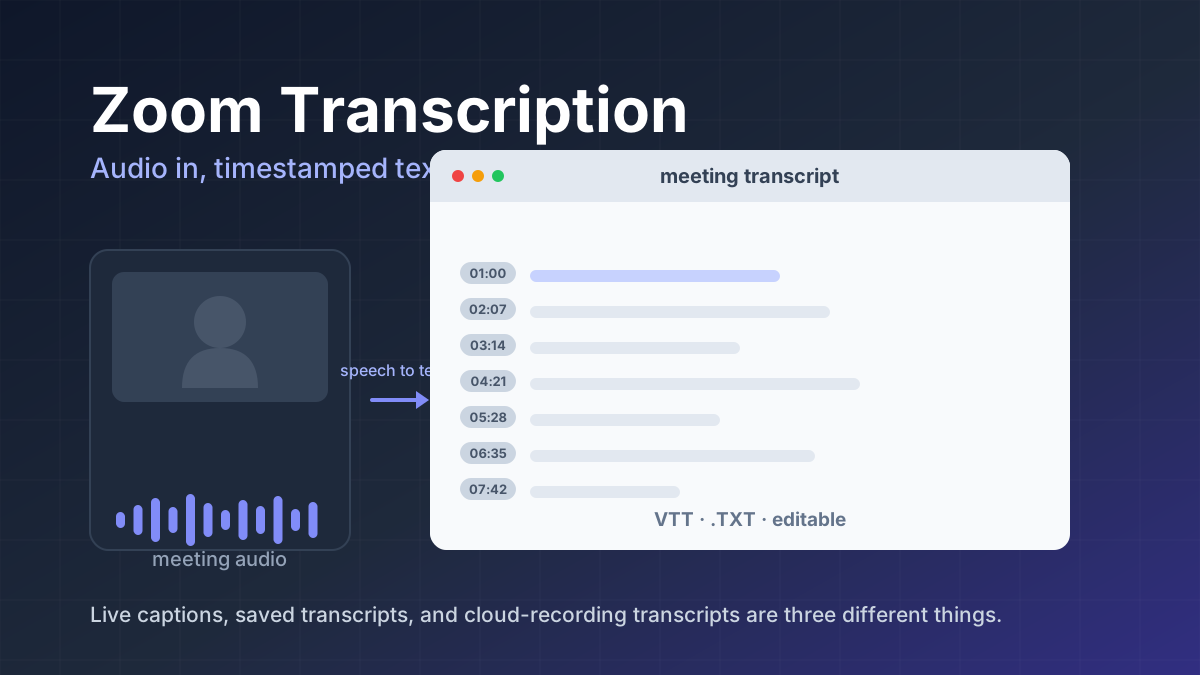
Zoom transcription turns meeting audio into text. Learn the difference between transcripts, captions, and AI summaries, how to enable them, and when to use third-party tools.
Jawad Fiaz Guides & How-To
An AI agent icon can name an agent, mark an AI feature, show live status, or point at a tool. Here is what the common symbols mean, where to find one, and what to check before you ship it.
AI Tools Vault Team