
Consensus AI Review
Research & EducationFreemiumAI academic search engine that finds, synthesizes, and summarizes evidence from 200M+ peer-reviewed scientific papers, with every answer cited to real research.
What Is Consensus AI?
Consensus AI is an AI academic search engine that answers research questions using evidence from more than 200 million peer-reviewed papers. Where a normal search engine ranks web pages, it ranks scientific studies, then uses large language models to read them and summarize what the evidence actually says.
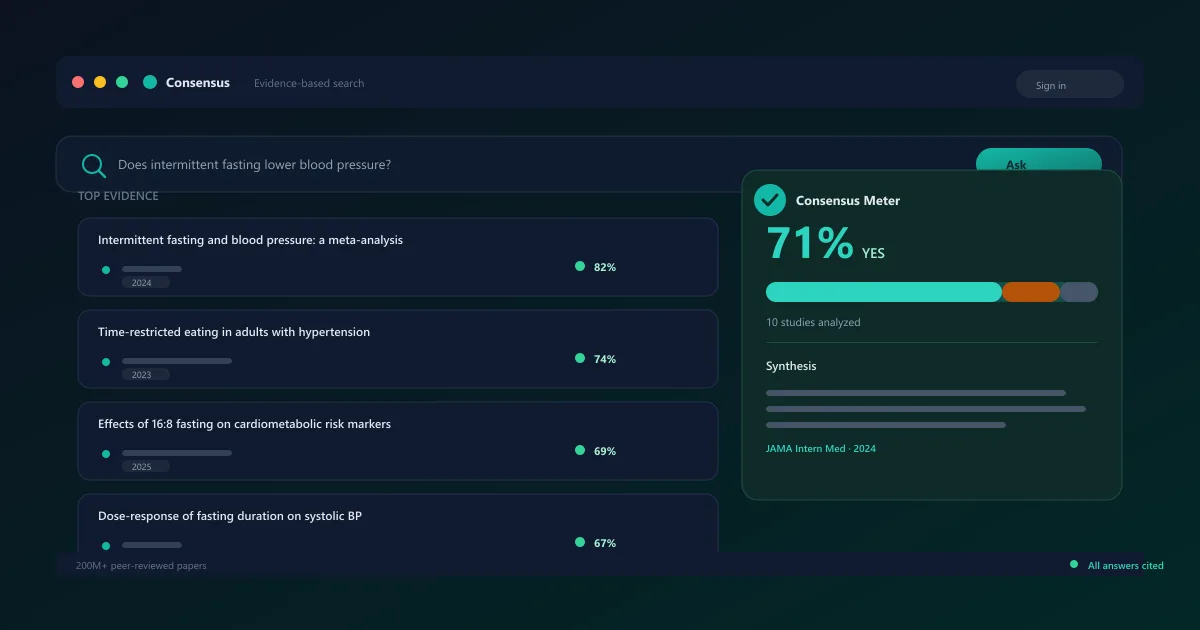
You type a question like "Does intermittent fasting improve blood pressure?" and it pulls the relevant studies, synthesizes the findings, and shows a Meter indicating what percentage of papers agree. Every statement is linked to the exact source paper, so claims can be verified in seconds.
Launched in 2021, the platform is aimed at researchers, students, and clinicians who want answers grounded in real science rather than SEO-ranked content. It turns hours of literature searching into a few seconds of evidence-checking.
The underlying engine covers the full academic workflow: finding studies, reading them, synthesizing findings, and exporting citations. That breadth is why it has become a go-to research tool in universities and clinical settings.
The search experience is fast enough to replace a textbook lookup for many questions, and the citation trail means nothing has to be taken on faith. That combination — speed plus verifiability — is the main reason Consensus AI gets recommended among graduate students and medical residents, who need dependable answers under time pressure.
Consensus AI Search Engine
The search engine is the heart of Consensus AI. Enter any natural-language question and it scans the paper database to surface the most relevant studies, ranked by relevance and recency rather than web popularity.
Each result card shows the study title, journal, publication year, and key stats like sample size and effect direction, so you can skim findings without opening every PDF. Clinical mode further restricts results to human studies for medical questions.
Advanced filters narrow results by study type, year, journal, and population, which matters when you need recent evidence or a specific methodology. Saved searches keep recurring topics one click away, and alerts can notify you when new relevant papers are published.
- Natural-language questions, not keyword queries
- Index of 200M+ peer-reviewed papers
- Cards with methods, outcomes & sample sizes
- Clinical mode limited to human studies
Consensus Meter — Scientific Agreement Tool
The Meter distills the scientific debate into a single visual: a horizontal bar showing the percentage of papers that agree, disagree, or are neutral on a question. It turns dozens of conflicting studies into a quick evidence read.
The Meter draws on the top relevant studies rather than the entire corpus, so the percentage reflects the direction of the strongest evidence. It's the fastest way to answer questions like "Does creatine improve strength?" with confidence.
The Meter works because Consensus AI understands study quality and direction, not just keyword matches. Conflicting results are shown honestly — a split bar tells you the literature is mixed rather than forcing a clean yes or no.
- Instant agree / disagree / neutral breakdown
- Based on the top relevant studies
- Color-coded evidence direction
- Linked to every contributing paper
Consensus AI Synthesis Tool
Beyond single answers, the synthesis tool produces cited overviews that summarize the evidence across a body of research. Ask for a general summary and it returns an AI-written paragraph plus an outline of the key takeaways, all sourced.
Deep Reviews go further, generating comprehensive literature syntheses with study-by-study breakdowns, methods comparisons, and limitations — a useful starting point for a manuscript or clinical briefing.
For instructors, the synthesis tool doubles as a teaching aid: students can see how evidence is gathered, summarized, and cited in a few clicks. That transparency makes it easier to teach critical evaluation of sources.
- Cited AI summaries with key takeaways
- Deep Reviews for comprehensive synthesis
- Study-by-study breakdowns and limitations
- Starting point for manuscripts and briefings
Consensus AI Citations
Citations are where the tool earns trust: every answer, summary, and Meter result links directly to the peer-reviewed papers behind it. You can open a study, check its claims, and never rely on a black-box answer.
Citation export is built in — send references to Zotero, Mendeley, or download RIS files. That makes it easy to move evidence into a reference manager without retyping anything.
Researchers appreciate that formatting stays consistent with the style guides used by major publishers, so pasted citations rarely need cleanup. That reliability is what keeps reference managers tidy over long projects.
- Every claim linked to its source paper
- One-click export to Zotero & Mendeley
- RIS file download for other managers
- No citation-lite answers
Consensus GPT — ChatGPT Plugin
The ChatGPT plugin brings this evidence engine into the world's most popular chatbot. Instead of ChatGPT guessing at a scientific answer, the plugin pulls peer-reviewed studies and returns cited, evidence-based responses.
The plugin suits students and professionals who already live in ChatGPT: ask a research question there and the answer comes back with real citations you can verify. It extends the same search and Meter logic into a conversational context.
Setup takes a couple of minutes in the ChatGPT plugin store, and the tool connects automatically to the same academic index used on the web. There is no separate account to configure for most users.
- Cited scientific answers inside ChatGPT
- Same 200M+ paper index as the web app
- Conversational research workflow
- Verify results by opening the linked papers
Consensus AI Pricing — Free vs Paid Plans
Searching the paper database on Consensus AI is free — you pay for the depth of AI analysis. The free plan includes unlimited paper searches plus a limited number of Pro messages and Deep Reviews each month.
Pro starts at $12/month billed annually ($20 monthly) and unlocks unlimited Pro messages with the full synthesis and Meter features. Deep at $45/month billed annually ($65 monthly) targets researchers doing frequent literature reviews, with 200 Deep Reviews per month. Students, faculty, and clinicians get up to 40% off.
Teams and Enterprise plans add usage analytics, shared workspaces, and priority support, with pricing set per seat. The free tier is generous enough that a full semester of coursework can often be completed without upgrading.
Compare Plans & Pricing
Free tier with unlimited paper search; Pro $20/mo ($12/mo billed annually); Deep $65/mo ($45/mo billed annually)
Free
Keep using basic paper search for free.
- Unlimited paper searches
- 15 Pro messages per month
- 3 Deep reviews per month
- AI-powered search & analysis
Pro
Unlimited Pro messages with cited AI analysis.
- Unlimited Pro messages
- 15 Deep reviews per month
- Agreement Meter & synthesis
- Export to Zotero & Mendeley
Deep
For researchers and clinicians doing frequent literature reviews.
- 200 Deep reviews per month
- Comprehensive Lit Reviews
- Citation graph tools
- Unlimited access to every tool
Consensus AI vs Perplexity
Perplexity is a general-purpose AI search engine that mixes news, web pages, forums, and academic papers into a single answer stream. It's broader, faster for everyday questions, and has a generous free tier.
It is narrower but deeper: every answer is grounded in peer-reviewed science with a Meter and full citations. For medical, clinical, or scientific questions, that evidence-first approach matters; for general knowledge, Perplexity is more versatile.
In practice, many people use both: Perplexity for quick general research and this engine when they need to confirm claims against the scientific literature. Each fills a different part of the research workflow.
Consensus AI vs Elicit
Elicit is built for researchers running systematic reviews — it extracts data into tables, screens papers by criteria, and manages large literature sets. It's a workhorse for structured research workflows.
This tool is the faster evidence-checking option: type a question, get an agreement Meter and a cited synthesis in seconds. For quick clinical or scientific answers it wins; for building a data-extraction matrix across hundreds of papers, Elicit is the stronger fit.
Both tools offer a free tier, so the practical test is easy: run the same question through each and compare how the answers handle citations and synthesis. Most researchers keep both bookmarked.
Pros and Cons
Consensus earns strong marks in several areas, with a handful of caveats covered below.
Weight the trade-offs by how often you run deep literature work — heavy review users will outgrow the free tier quickly, while light researchers may never need to pay.
Pros
- Searches 200M+ peer-reviewed papers
- Answers come with real citations
- Agreement Meter shows study agreement
- Generous free tier for paper search
- Export citations to Zotero & Mendeley
Cons
- Free tier limits AI analysis
- Not a full systematic review tool
- Full paper texts are not included
- AI summaries can miss nuance
Best For
Recommended use cases and scenarios where Consensus shines.
Frequently Asked Questions
Common questions about Consensus, answered.
What is Consensus AI?
It's an AI academic search engine that answers research questions using evidence from more than 200 million peer-reviewed papers, with cited summaries, an agreement Meter, and citation export.
Is Consensus AI free?
Yes, with limits. The free plan includes unlimited paper searches plus 15 Pro messages and 3 Deep Reviews per month. Unlimited AI analysis starts at $12/month billed annually.
How accurate is the Consensus Meter?
The Meter reflects the direction of the top relevant studies for a question, expressed as a percentage of papers that agree, disagree, or are neutral. It's a reliable evidence read, not a statistical meta-analysis.
Is Consensus AI better than Perplexity?
For scientific and clinical questions, yes — every answer is cited to peer-reviewed research. Perplexity is more general-purpose and covers news and web content, so the right choice depends on the question.
How does Consensus AI pricing work?
It's freemium. Free includes unlimited paper search with limited AI analysis; Pro is $12/month billed annually for unlimited Pro messages; Deep is $45/month billed annually for heavy literature work. Students and faculty get up to 40% off.
Reviews & Ratings
Loading reviews...
Explore More AI Research Tools
Browse the full AI Tools Vault directory to compare Consensus with every AI research and education tool, or line up your shortlist side by side.
Similar Tools
More Research & Education tools you might like

Socratic by Google
Google's AI homework helper app that uses your camera to read problems and explains answers across math, science, history, and more — 100% free.

Caktus AI
AI study platform for students with 25+ purpose-built tools - essay writer with citations, step-by-step math solver, humanizer, and research assistant.

Guides & Articles about Consensus
Read our detailed reviews and comparisons covering Consensus
 Guides & How-To
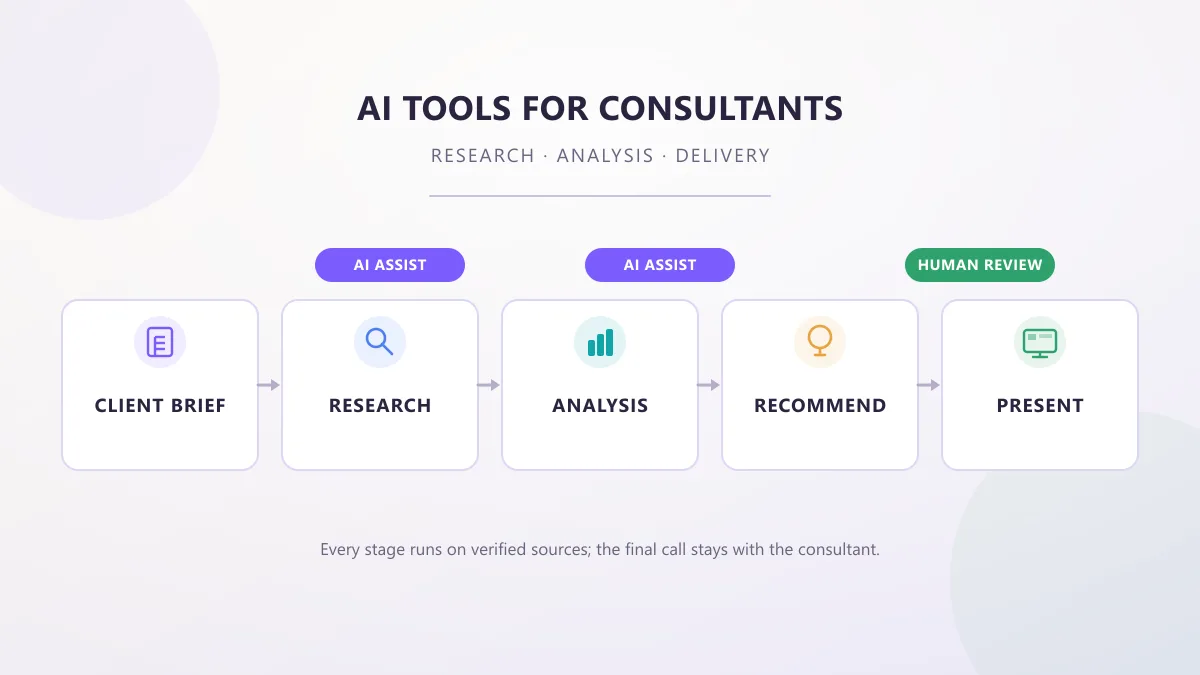
AI Tools for Consultants: Research, Analysis & Delivery
AI tools for consultants in 2026, organized by the work a consultant actually does — research, analysis, proposals, meetings, and decks — with practical prompts, workflows, and client-data checks.
 AI Tools Vault Team
 Guides & How-To
Best AI Tools for Students and Researchers in 2026
Six practical AI tools for students and researchers in 2026 — literature review, paper reading, study help, and writing polish, with verified pricing and honest first-hand notes.
Jawad Fiaz Guides & How-To
AI Tools for Students: Which Tool Works for Which Task
Ten AI tools for students matched to real study tasks — research, notes, writing and math — with free tiers, limits and honest drawbacks.
Jawad Fiaz