DeepSeek V4.1-Flash Review: Pricing, Context & API
ChatbotsFree
Best for: Coding, agents & low-cost API workloads
DeepSeek is the Chinese AI lab behind a free chat app and the deepseek-flash API. The current V4.1-Flash model adds native image understanding, a 1M-token context window, and low per-token pricing with off-peak rates.
DeepSeek is a Chinese AI lab, and the name also covers its free chat product and its paid developer API. In September 2026 the company moved its Flash line to DeepSeek-V4.1-Flash, a new architecture that adds native image understanding and a much smaller KV cache while keeping the API focused on high-throughput, lower-cost workloads.
There are three separate ways to use it. The chat app runs free on web and mobile with no subscription. Developers call the API and pay per token, and the published weights can be downloaded and self-hosted. Each path has its own costs and its own data-handling rules, so this review keeps them distinct.
What Changed in V4.1-Flash
The headline change is architectural. The new Flash model is a 552-billion-parameter mixture-of-experts model that activates roughly 8B parameters while reading input and 16B while writing output, under a Causal Encoder-Decoder design. For a developer the practical effect is lower cost per request, because the model does less work per token.
DeepSeek also shrinks the KV cache to about a quarter of the HBM and an eighth of the SSD used by the previous generation. Smaller caches cut the expense of long-running agents, where the same prompt prefix repeats across many calls. The official release note ties the lower API prices directly to this efficiency gain.
The other visible change is vision. The older V4 Flash had no image input; a separate V4 Flash Vision preview did. V4.1-Flash folds native visual understanding into the main model, so one model handles text, images, tool calls, and long context. DeepSeek reports that its own evaluations put it ahead of V4 Pro on several agent and coding benchmarks; we treat those figures, published in the release note, as vendor-reported rather than independent proof.
The old model names are being retired. Requests to deepseek-v4-flash and deepseek-v4-flash-vision-exp still work but are served by the current model and billed at Flash rates, per the official changelog. The same is true for deepseek-v4-pro since 04:00 UTC on September 14, 2026, and this routing continues until V4.1 Pro ships.
New Causal Encoder-Decoder architecture, 552B-parameter MoE
Native image understanding in the main Flash model
KV cache cut to roughly 1/4 HBM and 1/8 SSD
Legacy Flash and Pro names routed to the current model
Chat vs API: Two Separate Products
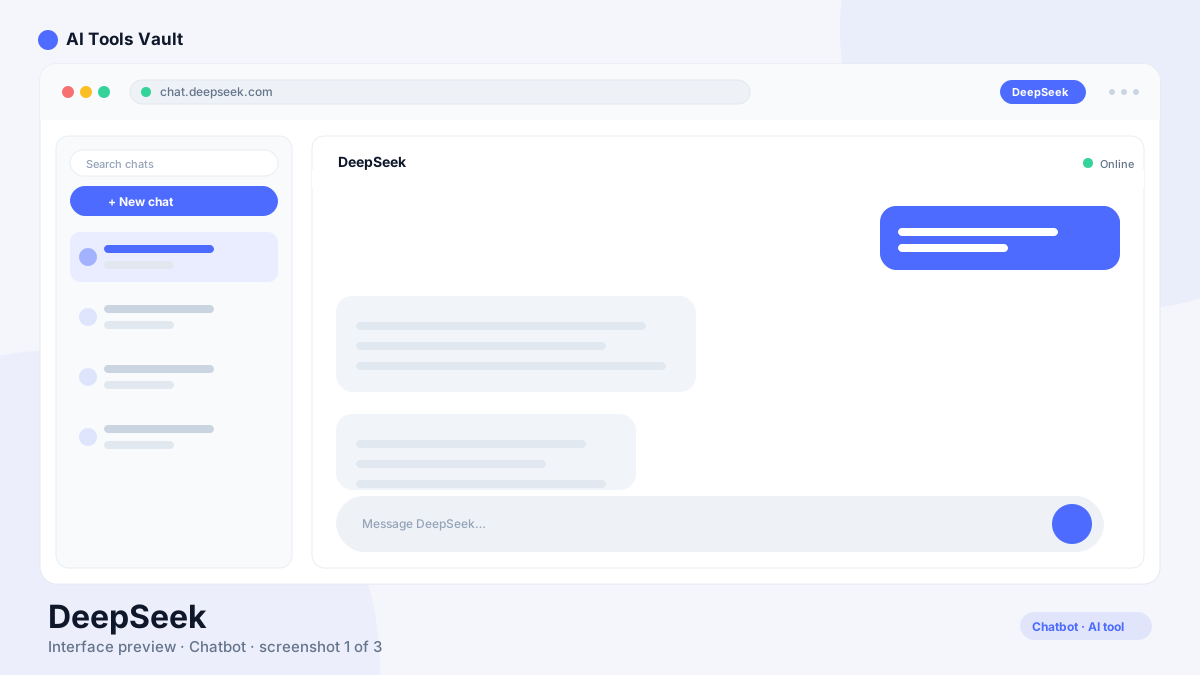
The chat product is for normal users. It runs at chat.deepseek.com and in the official iOS and Android apps, and it is free, with no subscription and no per-token billing. You type or upload files, and the model answers with its thinking mode on by default. DeepSeek's site describes the app as an assistant for coding, content creation, and file reading, with long-context support.
The API is for developers. It bills per token at published rates under the model name deepseek-flash, accepts OpenAI-style calls at api.deepseek.com, and also exposes an Anthropic-compatible endpoint at api.deepseek.com/anthropic. Chat prices never apply to the API, and API prices never apply to the free app. If someone quotes you a DeepSeek price, ask whether it is for the chat subscription (there is none) or for API tokens.
Chat: free web and mobile app, no payment, thinking mode on by default
Open weights: download and self-host, or use a hosted provider
Pick the path that matches what you are building before you compare prices
DeepSeek V4.1-Flash API Pricing
The official pricing page lists rates per million tokens for the current Flash model. Off-peak, input on a cache miss is $0.15, output is $0.60, and a cache hit costs $0.003. Peak rates are exactly double: $0.30 input, $1.20 output, and $0.006 on a cache hit.
A cache hit happens when the API reuses part of your prompt from an earlier call, so repeating a long system prompt or context block is far cheaper than sending it fresh each time. Peak hours are Monday to Friday, 01:00-04:00 and 06:00-10:00 UTC, excluding Chinese public holidays; everything else counts as off-peak, including weekends. For context, the current Pro-priced row charges $0.66 input and $1.98 output off-peak, but its traffic now routes to the Flash model at Flash rates until V4.1 Pro launches.
What the Flash endpoint supports, from the same docs: tool calls, JSON output, the Responses API, an Anthropic-compatible API, chat prefix completion and FIM completion (beta), plus vision. FIM completion runs in non-thinking mode only.
Compare Plans & Pricing
DeepSeek chat is free on web and mobile apps. API: deepseek-flash from $0.15/M input (cache miss) and $0.60/M output off-peak; peak rates are double; cache hits from $0.003/M. Open weights (MIT) may be self-hosted.
Most Popular
DeepSeek Chat
$0free
Free web and mobile chat with the current model and no subscription; the chat product is not billed per token.
Peak pricing is the rate charged during the busiest hours of the API; off-peak is everything else, and it is always 50% of peak. So 1 million output tokens cost $0.60 off-peak and $1.20 at peak, and 1 million input tokens on a cache miss cost $0.15 off-peak and $0.30 at peak. That arithmetic comes straight from the published table.
Whether the difference matters depends on volume. Batch jobs and background agents can usually wait for off-peak hours; interactive apps cannot. DeepSeek publishes no official promise of savings beyond the price difference itself, so this page claims nothing more than the rates listed.
What a 1M Token Context Means in Practice
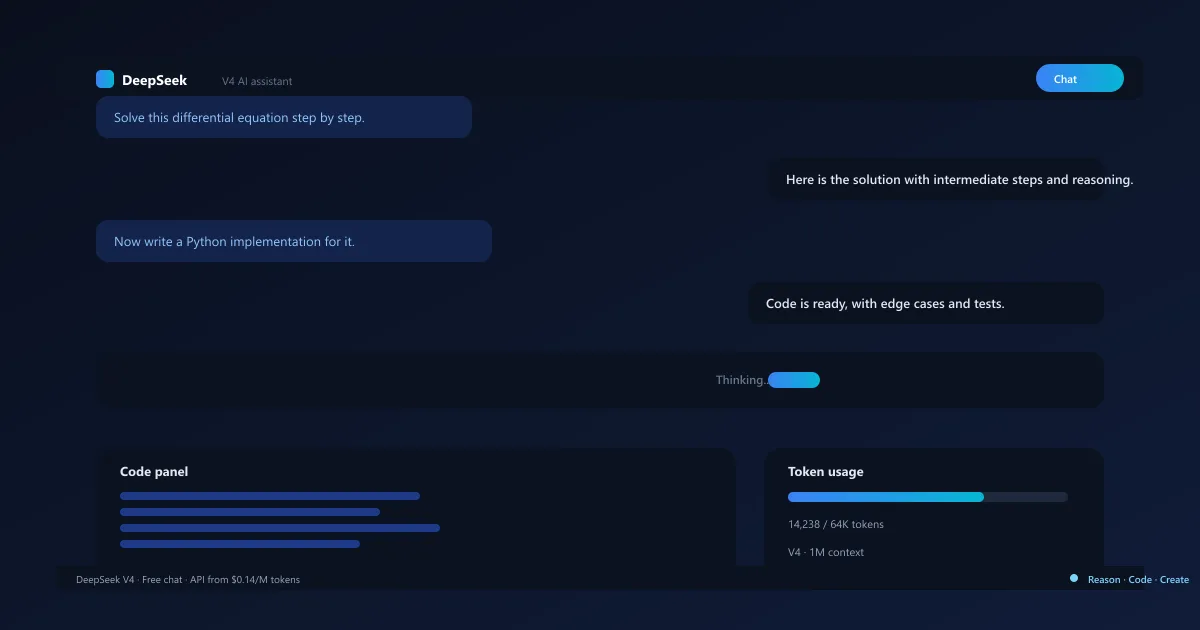
Context length is the amount of input and output the model can work with inside one request. For the current Flash model the documented ceiling is 1M tokens in, with output capped at 384K tokens. "Remembers one million tokens" is a bad shorthand: the window is a limit, not a guarantee of understanding.
In practice it covers large codebases, long documents, and multi-file work, letting you read a full repository or a set of long PDFs in one call instead of splitting the task across many prompts. But more context is not automatically better. Very long inputs can contain irrelevant or noisy material that drags answers down, and a bigger window does not improve reasoning quality by itself. Plan inputs like you would a brief for a human colleague.
Read an entire codebase or repo in a single call
Summarize or query long contracts, reports, and papers in context
Keep a long agent session with its history in one window
Output long drafts up to 384K tokens in one completion
Rate Limits and Concurrency
The rate-limit docs document account-level concurrency limits: 2,500 concurrent requests for deepseek-flash and 500 for deepseek-v4-pro. A request counts as one concurrent connection from the moment it is sent until the response finishes. That is not the same as 2,500 requests per minute; concurrency is how many requests are in flight at the same time.
The limit applies per account across every API key, and requests beyond it receive an HTTP 429. Teams that need more can submit a capacity expansion request through DeepSeek's form, which the docs say carries no extra cost. A user_id parameter also gives per-user isolation for content safety, KV cache, and scheduling within your own account.
First-Hand Experience: What We Could Verify
We need to be straight about this: a fresh hands-on test could not be reproduced in this environment during this update, because no API key or test console was available. Nothing here is invented from a pretend session, and no benchmark figures or screenshots were fabricated to fill the gap.
What we verified directly against official DeepSeek pages: the release note and changelog dated September 10, 2026, the current pricing and feature tables, the rate-limit page, the Hugging Face model card, and the current privacy policy. Anything labeled vendor-reported comes straight from DeepSeek's own materials, and independent tests of this specific build may differ from them.
If you want to check behavior yourself, the quickest path is the free chat: run one coding task, one long-document task, and one image task, then compare against a second model. For the API, the docs show how to switch the model name to deepseek-flash with any OpenAI-style client and keep the reasoning effort at a level you can afford.
Who It Is For
The strongest fit is developers and coding-agent users. The API documents tool calls, JSON output, the Responses API, an Anthropic-compatible endpoint, and a default thinking mode, and DeepSeek publishes agent integrations for tools such as Claude Code and OpenCode.
It also suits teams building products where price per token matters, researchers working with very long documents, users who need image and text handled by one model, and anyone willing to run large open weights on their own hardware.
Developers and coding agents on a budget
API products with high token volume
Long-document and multi-file research
Image-plus-text tasks in one model
Teams that can host large open-weight models
Who May Not Need It
People who only want a simple consumer chat experience may find this chat product lean compared with rival ecosystems that ship image generation, voice, agents, and deeper workspace integrations. If your team already works inside another vendor's stack, switching mid-project rarely pays for itself.
Teams that need a specific enterprise compliance posture, or that must avoid sending data into a service that processes inputs in China, should pick a provider whose setup matches their requirements. And no one should plan to self-host the open weights without the GPU infrastructure to actually run them.
Privacy and Data Handling
DeepSeek's privacy policy covers its apps, websites, software, and related services, and it lists user input, including text, voice, prompts, uploaded files, and chat history, among the personal data it processes. The policy says data may be used to train and improve the technology, describes a right to opt out of that use for your data, and states that personal data is processed and stored in the People's Republic of China.
The same policy does not cover apps that other developers build on the platform; that responsibility sits with the developer. The rules also differ in practice between the chat app, the DeepSeek API, the open-source harness, and a third-party hosted deployment, so "does this provider train on my inputs?" has different answers for each path. Treat the policy for the specific service as the authority.
Practical guidance, in plain terms: keep secrets and sensitive personal data out of prompts, know which service you are calling, check the opt-out controls in settings, and read the privacy policy before putting confidential material into any consumer AI product. This is general advice, not legal advice.
Open-Weight and Local Access
The weights for V4.1-Flash are published on Hugging Face under an MIT license, alongside a technical report, and the model card documents inference with vLLM, SGLang, and Transformers. In practice, downloadable is not the same as runs on a laptop: the backbone is 552 billion parameters (about 763 billion parameters total across the safetensors files in BF16, FP8, and INT8), so real deployment means multi-GPU servers, careful memory planning, or a quantized build.
If self-hosting is too heavy, hosted inference providers serve the model without local hardware, and smaller open-weight models from other labs demand less infrastructure. For simply trying the latest build quickly, the free chat or the API is the realistic entry point; running the weights yourself is a deployment project.
DeepSeek vs Current Alternatives
Against today's field, the useful comparisons are about fit rather than a single winner. GPT-5.6-class models from OpenAI and the Claude 5-generation models from Anthropic are stronger on some general tasks and ship richer tool and integration ecosystems. By contrast, the current Flash API undercuts most of them on price per token, which matters when you move high volumes. There is no objective sense in which one family beats all others across every workload.
Google's Gemini line is a common multimodal alternative with strong document handling and its own low-cost tiers. Among open-weight rivals, Kimi K3 and GLM-5.3 sit near the frontier with permissive licenses and different hardware profiles. For coding agents specifically, Claude Code, OpenAI Codex, and DeepSeek's own agent integrations each package a model differently, so the right pick depends on your workflow, your context needs, and what you will pay per call. You can line models up side by side with the compare tool.
ChatGPT
ChatbotsFreemium
Best for: General conversations & writing
OpenAI's flagship conversational AI for writing, coding, analysis, and creative tasks. ChatGPT answers questions, writes content, and analyzes files in one place.
It is the current Flash-generation model, released September 10, 2026 and served through the API as deepseek-flash. It adds native image understanding and a smaller KV cache, and the older Flash model names now route to it.
How much does the DeepSeek API cost?
For deepseek-flash, input costs $0.15 per million tokens on a cache miss and output costs $0.60 per million, off-peak; peak hours double both. Cache hits are $0.003 per million off-peak. The consumer chat product stays free.
What is DeepSeek's context window?
The API documents a 1M-token context for the current model with a 384K maximum output. Results still depend on the quality of what you put into the window, not just its size.
Is DeepSeek V4.1-Flash multimodal?
Yes. The current Flash model natively understands images as well as text, and the vendor says the chat product runs the same generation. The Pro endpoint does not list vision support.
Can DeepSeek V4.1-Flash be downloaded?
Yes. The model weights are published on Hugging Face under an MIT license. It is a large model, so self-hosting needs serious GPU hardware; hosted access is also available through third-party providers.
Is DeepSeek safe for sensitive information?
That depends on the service. DeepSeek's privacy policy says inputs may be used to improve its services, describes an opt-out, and states data is processed and stored in China. Avoid sending secrets, and read the policy for the service you use.
Reviews & Ratings
Loading reviews...
Explore More Chatbots Tools
Browse the full AI Tools Vault directory to compare DeepSeek with every chatbots tool, or line up your shortlist side by side.
OpenAI's flagship conversational AI for writing, coding, analysis, and creative tasks. ChatGPT answers questions, writes content, and analyzes files in one place.



 Guides & How-To
 AI Tools Vault Team
 Guides & How-To
 Guides & How-To