

Atlas by World Labs Review: A World Model, Not Just a Video Generator
VideoFreemiumAtlas by World Labs is an omni world model that generates camera-controlled video, images, and 3D scenes from text with pixel-perfect control.
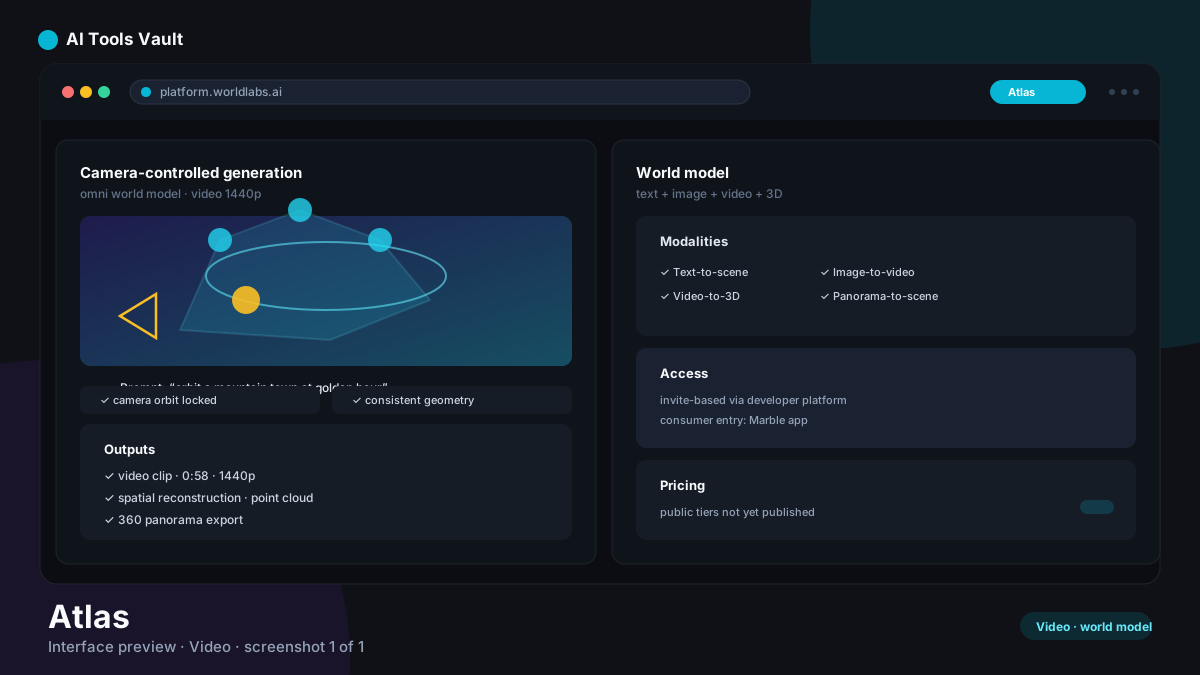
What Is Atlas by World Labs and How Does It Work?
Atlas by World Labs is a next-generation omni world model, meaning it reasons about the physical world instead of only pasting words to pixels. It was pretrained from scratch on text, images, video, and 3D data, using a multimodal autoregressive diffusion transformer in which every image and depth map is grounded at a 3D position. This shared spatial context lets the model generate what comes next while staying consistent with everything it has already seen.
Because the model accepts camera poses, camera positions, and 3D depth maps as native inputs, users can steer the virtual camera rather than describe it in a text prompt. In practice, it behaves as one system that generates controllable video frames, reconstructs scenes in 3D, and simulates how space and time behave.
World Model vs Video Generator: Why the Difference Matters
Most AI video tools predict the next frame from a prompt. A world model like Atlas from World Labs instead maintains a consistent 3D scene and renders views of it, so the geometry holds together as the camera moves. That changes what you can do with one output: reframe a shot, walk around an object, or hand the scene to a robot as training data.
This is why Atlas by World Labs is rarely compared head-to-head with text-driven video generators in practice. It competes on spatial coherence, not just clip length or sharpness, and its roadmap points toward simulation and robotics as much as filmmaking.
- Predicts a consistent 3D world, not just the next frame
- Outputs are spatially grounded for reframing and reuse
- Built for simulation and robotics alongside creative use
Camera-Controlled Video Up to a Minute at 1440p
The headline capability is camera-controlled generation. The model takes one or more reference images, from a single photo up to six input images for video, and generates new views at any camera position and angle you specify using pixel-perfect camera geometry. Videos run up to one minute long at 1440p resolution along a hand-designed camera path.
Where text-driven tools ask you to describe the shot, this model lets you frame it. You specify the camera path directly, and the model extrapolates beyond the visible inputs by drawing on world knowledge to fill in the unseen parts of the scene.
- Generates video from one to six input images
- Pixel-perfect camera control with hand-designed paths
- Up to 1 minute of video at 1440p resolution
- Scene stays consistent as the camera moves
Spatial Reconstruction and Explicit 3D Outputs
Atlas from World Labs reconstructs real-world spaces from one to dozens of input images. It generates both image frames from novel views and explicit 3D outputs such as point clouds and 3D Gaussian splats, outperforming specialist reconstruction models while working from far fewer views. Faithful reconstructions typically need as few as two or three images, though the spatial context can hold over a hundred.
That sparse-input strength matters for production. A few cell phone photos become a navigable 3D environment without a lidar rig or a dense photogrammetry set, which is why VFX, games, and robotics teams are among the first targets.
- Novel-view generation from sparse input images
- Explicit 3D outputs as point clouds or Gaussian splats
- Outperforms specialized reconstruction models
- Fewer capture views than traditional photogrammetry
Space-Time Simulation and Robotics
The same spatial foundation doubles as a world simulator. It can reframe ordinary multi-camera footage into bullet-time shots from impossible angles, captured with a few cell phones rather than a professional studio. It also supports Real-to-Sim robotics workflows, where a robot navigates a reconstructed space and the model generates the sensor data it would observe along the way.
Today this is best understood as scene generation for simulation rather than a verified physics engine. World Labs has not yet demonstrated that objects inside generated scenes respond correctly to every action, so robotics teams should treat it as a training-content tool until independent testing fills that gap.
- Reframing video from three to five camera views
- Bullet-time effects without expensive capture equipment
- Real-to-Sim environments and sensor data for robotics
- Still a scene generator, not a verified physics simulator
Image and 360 Panorama Generation
Although its focus is world modeling, it is also a capable image generator. It follows complex prompts, renders legible text, and produces a wide variety of visual styles. It can also generate 360 panoramas from text or image prompts, using the same spatial understanding behind its video and 3D capabilities.
- Complex prompt following with legible text rendering
- 360 panorama generation from text or images
- Wide variety of visual styles
Benchmarks and Verification: What to Trust
World Labs reports that Atlas outperforms recent video models at camera-controlled generation, with third-party human raters preferring it more often as camera paths get more complex, and that it beats specialized open-source models on sparse 3D reconstruction benchmarks. These were internal evaluations: no academic paper or independent replication was published at launch, and in the camera tests rivals described the path in text while Atlas received native camera data.
Treat the headline numbers as directional evidence from the vendor until third-party results appear. For teams adopting early, the practical tests are geometry that stays consistent, seams when reference images disagree, and outputs that survive interaction in simulation.
- Human raters preferred Atlas more on complex camera paths
- Beats specialized open-source models on sparse reconstruction
- Results are self-reported with no paper at launch
- Independent replication is still pending
Pricing and Availability
Atlas was introduced on September 1, 2026, and entered early access with select partners through the World Labs site. Atlas by World Labs has not published stable public pricing tiers, so budgets should be confirmed with World Labs when access is granted. The model will also power future versions of the Marble app, which expands the consumer entry point over time.
- Early access with select partners as of September 2026
- No published public pricing tiers yet
- Will power future versions of the Marble app
Security and Data Privacy
World Labs publishes a security page that encourages responsible disclosure of vulnerabilities through security@worldlabs.ai, and it does not currently operate a public bug bounty program. Its privacy policy notes that account details and user-submitted content, including spatial data, may be used to develop and train its models, with an opt-out mechanism described in the terms of service. As with any AI service, absolute security is not guaranteed.
Because Atlas generates 3D geometry from your inputs, treat sensitive scenes accordingly. World Labs also disclaims that AI-generated worlds may not accurately represent real-world physics or spatial relationships.
- Responsible disclosure via security@worldlabs.ai
- No public bug bounty program as of this writing
- Review the privacy policy before submitting sensitive scenes
- Generated 3D may not match real-world physics exactly
Who Is Behind Atlas by World Labs?
World Labs was founded by Fei-Fei Li, the Stanford professor widely called the godmother of AI, together with computer vision researchers Justin Johnson, Christoph Lassner, and Ben Mildenhall. The company emerged from stealth in September 2024 with $230 million in funding at a valuation above $1 billion. In February 2026 it closed a fresh $1 billion round that included a $200 million investment from Autodesk, strengthening its push into world models for 3D workflows.
- Founded by Fei-Fei Li, Justin Johnson, Christoph Lassner, and Ben Mildenhall
- $230M raised at launch in 2024 at a $1B+ valuation
- $1B round in February 2026, including $200M from Autodesk
Alternatives
On this directory, Sora is a generative video model from OpenAI, Runway is a broad AI video suite, and Meshy focuses on 3D asset generation. All three are self-serve products with public pricing, while Atlas remains in early access.
Beyond those, the world-model category is heating up: Odyssey is building interactive world simulation, Niantic Spatial works on geospatial mapping, and AMI Labs under Yann LeCun is pursuing controllable physical models. Atlas by World Labs differentiates itself as a single omni model with native camera control, spatial reconstruction, and explicit 3D output, while the tools above are easier to adopt today for generation that is publicly priced and immediately available.
- Sora: OpenAI generative video model
- Runway: broad AI video production suite
- Meshy: 3D asset generation
- Odyssey, Niantic Spatial, AMI Labs: other world-model players
Best For
Recommended use cases and scenarios where Atlas shines.
Pros and Cons
The strengths are breadth, control, and research pedigree. A single omni model spans video, images, and 3D with native camera control, built by a well-funded spatial-intelligence team behind ImageNet pioneer Fei-Fei Li. That is a meaningful technical leap over most clip generators.
The tradeoffs are access, verification, and maturity. It is limited to select partners with no published pricing, its benchmark claims lack independent validation, and it carries no verified third-party reviews yet. For teams that need production-ready, publicly priced generation immediately, it is not yet a drop-in.
Pros
- Atlas by World Labs handles text, image, video, and 3D in one omni model
- Pixel-perfect camera control up to one minute at 1440p
- Spatial reconstruction with explicit 3D outputs
- Space-time simulation for reframing and robotics
- Backed by World Labs and $1B+ in funding
- Creates images and 360 panoramas from text
Cons
- Atlas by World Labs is limited to early-access partners for now
- No published public pricing tiers yet
- Benchmarks are self-reported with no independent paper at launch
- Early-stage world model with evolving capabilities
- No verified user reviews in this catalog yet
Frequently Asked Questions
Common questions about Atlas, answered.
What is Atlas by World Labs?
Atlas by World Labs is an omni world model from World Labs that generates camera-controlled video, reconstructs scenes in 3D, simulates space and time, and creates images and 360 panoramas from text.
Who makes Atlas?
It is built by World Labs, the spatial-intelligence company co-founded by Fei-Fei Li, Justin Johnson, Christoph Lassner, and Ben Mildenhall, which launched in 2024 with $230 million in early funding.
How long can the generated video be?
It can generate camera-controlled video up to about one minute long at 1440p resolution from one to six input images.
When did Atlas launch?
Atlas was introduced by World Labs on September 1, 2026, and is entering early access with select partners.
Is Atlas by World Labs free?
Atlas by World Labs is in early access with select partners, and World Labs has not published public pricing tiers. Confirm costs when access is granted.
Is this the same as OpenAI's Atlas?
No. OpenAI's Atlas is a separate browser product. This Atlas is the World Labs omni world model for video, image, and 3D generation.
Who should use Atlas by World Labs?
Creators, filmmakers, developers, and robotics researchers who want controllable world-model generation from a single early-stage model.
Reviews & Ratings
Loading reviews...
Similar Tools
More Video tools you might like

Loom AI
Async screen recording with built-in AI that writes titles, summaries, chapters, and action items from every recording.

CapCut
CapCut is ByteDance's free AI-powered video editor for short-form content, with auto captions, background removal, and a huge template library for TikTok and Reels.
