Best AI Shopping Assistants in 2026: Top 6 Compared
AI shopping assistants are reshaping how shoppers research products, compare prices, and check out. Here are the ones worth knowing in 2026.

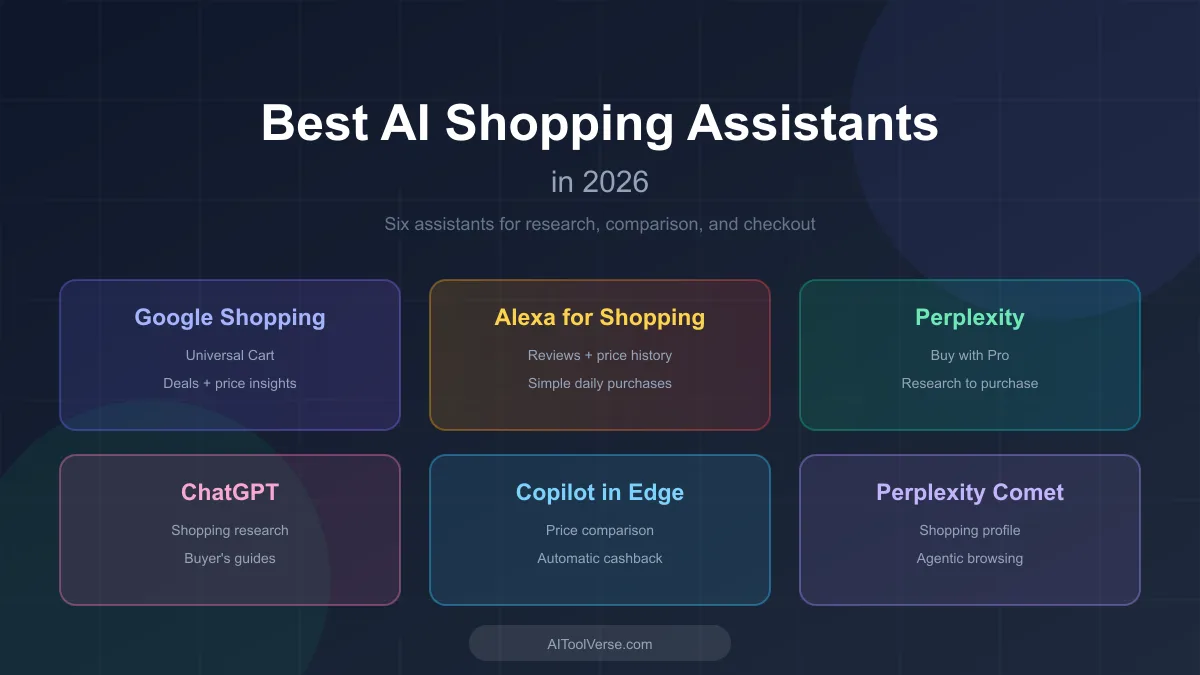
AI shopping assistants are reshaping how shoppers research products, compare prices, and check out. Here are the ones worth knowing in 2026.
Online shopping has quietly become a research project. You compare specs in one tab, skim reviews in another, hunt for the best price in a third, and start over when the first choice is out of stock.
These tools are changing that workflow. Instead of reading dozens of listings yourself, you describe what you need and the assistant reads the catalogs — pulling together specs, reviews, prices, and availability in one place. Some will even complete the purchase.
These assistants come in two flavors. Some live inside a retailer or marketplace, like Amazon's Alexa for Shopping or the shopping features built into Google Search. Others are general-purpose AI models with dedicated shopping modes, such as ChatGPT, Perplexity, and Microsoft Copilot.
By mid-2026, every major platform had shipped something. Google introduced a Universal Cart that checks out across multiple merchants in one transaction, built on the Universal Commerce Protocol and a Shopping Graph with more than 60 billion product listings. Amazon merged its Rufus assistant with Alexa to create Alexa for Shopping, ChatGPT gained a dedicated shopping research mode, and Perplexity made in-chat checkout free for all US users.
The core jobs an assistant typically handles:
The current generation of AI shopping assistants is built around conversational research. Instead of typing a category name, you describe an actual problem — a rainy three-day hike, running shoes for flat feet, a laptop for night-shift schedules. The assistant turns that into a curated shortlist and lists the offers it pulled from.
ChatGPT asks clarifying questions before it digs in, then returns a personalized buyer's guide. Amazon's assistant reads reviews and Q&A to answer specific questions. Google flags compatibility problems, such as a power supply that will not fit a custom PC build. Microsoft Copilot in Edge builds side-by-side spec comparisons while you browse, and Perplexity synthesizes reviews, specs, and pricing into product cards.
The shift is visible on the seller side too. Google's May 2026 Merchant Center update adds AI performance insights and conversational search tools, a sign retailers now treat AI shopping as a channel to optimize for.
Features vary a lot between assistants, and marketing demos rarely tell you what matters on a real purchase. These are the ones that actually change how you buy:
No single helper has all of them. Google Shopping leads on deals and price insights, Alexa for Shopping on review-driven purchasing, Perplexity on turning research into an order, and Copilot on comparison while you browse.
These tools work best in workflows, not one-off questions. The patterns that get the most out of them:
A concrete example: a travel backpack under $150 that fits a 15-inch laptop and passes as a personal item on a budget airline. A capable assistant narrows the field to four or five packs with capacity, weight, and airline-bin dimensions, then compares your top two side by side. You still confirm price, seller stock, return window, and recent reviews yourself. That split — the tool narrows, you verify — is where the feature saves the most time.
These are the assistants generating the most real-world use in 2026, from retailer-integrated helpers to general chat models with dedicated shopping modes.
| Assistant | Best for | Free | Details |
|---|---|---|---|
| Google Shopping | Deals, price insights, cross-merchant checkout | Yes | Universal Cart and agentic shopping |
| Amazon Alexa for Shopping | Reviews, price history, routine purchases | Yes | Rufus + Alexa+ combined, US launch |
| Perplexity | Research straight into a purchase | Yes (US) | In-chat checkout powered by PayPal |
| ChatGPT | Personalized buyer's guides | Yes | Shopping research in chat, mobile and web |
| Microsoft Copilot (Edge) | In-browser comparison and cashback | Yes | Built into Microsoft Edge |
| Perplexity Comet | Shopping-focused browser profile | Yes | Agentic browser with a shopping mode |
Announced at Google I/O on May 19, 2026, the new shopping experience pulls deals from Search, Gemini, YouTube, and Gmail into one place. Price-drop alerts, price history insights, back-in-stock notifications, and compatibility warnings for things like custom PC parts arrive automatically, with everything ranked by Gemini models.
The Universal Cart holds items from multiple merchants and checks out once, with the Universal Commerce Protocol letting any participating store accept a cart built elsewhere. It is rolling out in the US through Search and the Gemini app, with YouTube and Gmail to follow.
Amazon retired the standalone Rufus brand in the US and merged it with Alexa+ on May 13, 2026. Alexa for Shopping lives in the Amazon Shopping app, the website, and Echo Show devices, and does not require Prime or an Echo. It answers questions from the main search bar, builds personalized shopping guides for big purchases, and surfaces category and product insights in search results.
Two features stand out: dynamic product comparisons between specific items, and price history spanning up to a full year. The assistant also finds deals, builds carts, and handles routine purchases automatically. Amazon says Rufus helped more than 300 million customers during 2025.
Perplexity added shopping in late 2024 with Buy with Pro, a one-click checkout for US Pro subscribers. In November 2025 it made in-chat checkout free for all US users, powered by PayPal's agentic checkout, with participating PayPal merchants staying the merchant of record. Search results include unsponsored product cards with pros, cons, specs, and retailer availability.
That combination still feels unusual in 2026: a research tool that treats buying as part of the answer rather than an ad break. For shoppers who want research and purchase in one place, it remains one of the few tools that connects the two steps directly. You can read our full Perplexity AI review or see the same research style in a dedicated browser.
ChatGPT shipped shopping research on November 24, 2025, rolling out to logged-in Free, Go, Plus, and Pro users on mobile and web. Instead of listing products, it asks clarifying questions, researches on your behalf, and delivers a personalized buyer's guide. It is strongest in electronics, beauty, home and garden, kitchen and appliances, and sports and outdoor categories, and ran nearly unlimited through the 2025 holiday season.
The guide leans on your chat history and ChatGPT memory, so the questions it asks and the options it ranks adapt to how you have shopped before. For undecided shoppers, that guided question flow makes it feel like a shopping partner rather than another search box.
Copilot in Microsoft Edge handles shopping without a third-party extension. It compares prices across retailers, shows price history, and tracks deals while you browse. Product pages gain an insight layer that summarizes key facts, and a comparison table appears when you weigh two similar products.
Cashback is the differentiator: it is applied automatically during checkout in Edge, removing the "did I remember the button" problem of extension-based rewards — details on Microsoft's Edge blog. If you already live in Edge, this is the lowest-friction way to add Microsoft Copilot to a normal shopping trip.
Perplexity Comet takes the product research idea one step further by embedding it in a free, Chromium-based browser. Context-aware profiles switch its behavior for research, shopping, travel, and writing, so one address bar covers shopping questions instead of generic web search.
Comet keeps Perplexity's cited-answer format, so products come back with sources attached. For research-first shoppers, the shopping profile effectively adds an agentic shopping browser — no visits to a dozen retail sites.
The assistants still make real mistakes. Recommendations depend on what is indexed and available, so a heavily reviewed listing can beat a genuinely better product that lacks reviews. Local stock is frequently wrong, and checkout quirks (sanitized shipping options, region restrictions, gift-card limits) are exactly the fine print an assistant compresses away.
They are also opinionated in ways that are easy to miss. Google's results favor deal signals, Amazon's favor its own catalog, and ChatGPT's favor review quality — the same question can produce different answers on different platforms. That is not a bug, but it is a reason not to let any single system decide.
For small, replaceable purchases, letting an AI shopping assistant decide is reasonable. For big-ticket items, the AI shopping assistant should be a starting point, not the final word.
Verify warranty and return policy on the product page, check shipping and regional availability, and compare the assistant's pick against the brand's spec sheet. A two-minute check catches the mismatches assistants quietly merge away — size tolerances, connector incompatibilities, or a photo that does not match the shipped item.
What are AI shopping assistants?
AI shopping assistants are AI tools that help shoppers find products, compare options, check prices, and complete purchases. They summarize reviews, watch for price drops, and answer product questions in plain language instead of making you browse page after page of search results.
Are AI shopping assistants free?
Most are free to use. Google Shopping, Amazon Alexa for Shopping, and Microsoft Copilot in Edge do not require a subscription. Perplexity's in-chat checkout is free for US users, while ChatGPT makes its shopping research available to free users as well as paid plans.
Can AI shopping assistants actually buy things?
Some can. Amazon Alexa for Shopping can build carts and handle routine purchases, Google's Universal Cart pools items across merchants into one transaction, and Perplexity supports in-chat checkout through PayPal for US users. Other assistants stop at recommendations and send you to the retailer to finish.
Which AI shopping assistant is best for price tracking?
Amazon Alexa for Shopping shows up to a year of price history, Google Shopping adds price-drop and back-in-stock alerts, and Microsoft Copilot in Edge tracks price changes while you browse. The right one depends on where you normally shop.
Do AI shopping assistants replace regular searching?
Not completely. These assistants are strongest for product research and comparison, but they can still surface low-rated listings, miss local availability, or recommend items that are out of stock. For expensive purchases, verify the details yourself before checkout.
Will AI shopping assistants replace retailers like Amazon and Google?
No. The major assistants run on top of the same retailers and shopping engines that power ecommerce today. Google Shopping, Alexa for Shopping, ChatGPT, Copilot, and Perplexity all route purchases back to existing merchants instead of building a separate marketplace.
AI shopping assistants have moved from novelty to default in under two years, and they now cover research, comparison, tracking, and even checkout on most major platforms. Google Shopping is the pick for deals and cross-merchant checkout, Alexa for Shopping for Amazon purchases and price history, Perplexity when you want research to finish as an order, and Copilot in Edge when comparison should happen without leaving the tab.
Try two on one real purchase before you pick a favorite. The assistant that understands how you shop beats the one with the longest feature list.
Browse the full AI tool directory on AIToolVerse or compare your shortlist side by side with the compare tool.
Get our best AI tool reviews and guides delivered to your inbox each week. No spam, unsubscribe anytime.

Written by
Editorial Team
The AI Tools Vault editorial team researches, tests, and reviews the best AI tools across every category.
More reading on comparisons
 Comparisons
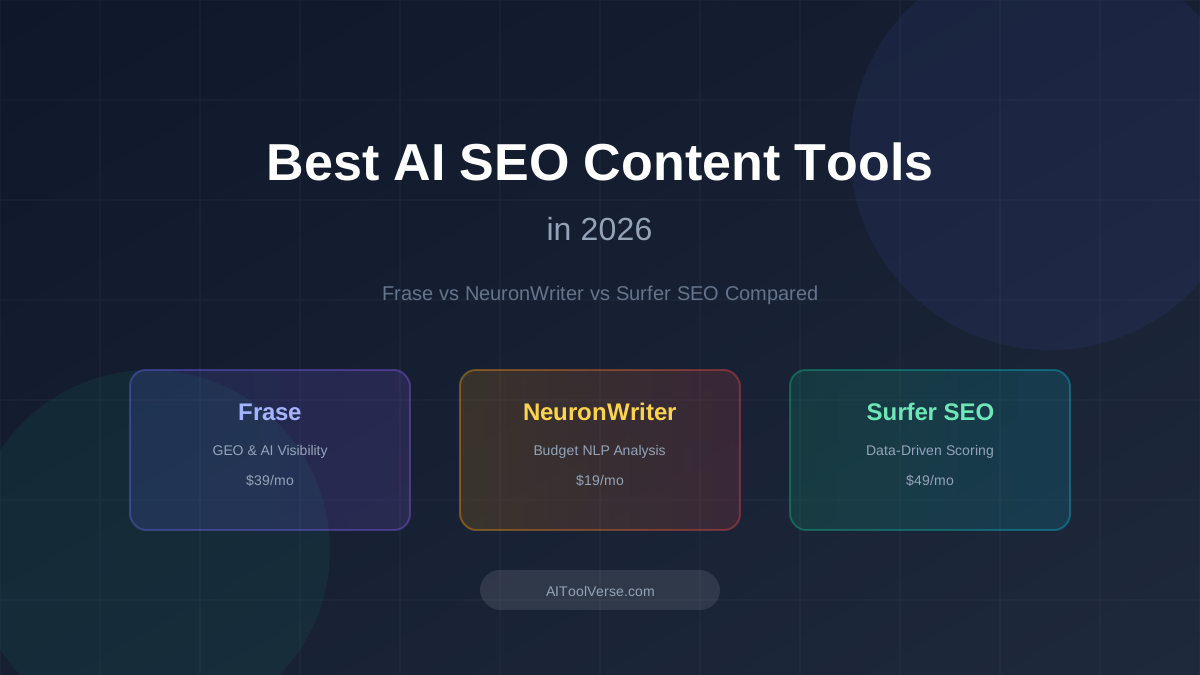
Three AI SEO content tools compared — Frase for GEO tracking, NeuronWriter for budget NLP analysis, and Surfer SEO for data-driven on-page scoring.
 AI Tools Vault Team
 Comparisons
The best AI marketing tools in 2026 compared — Jasper AI, Copy.ai, MarketingBlocks AI, and AdCreative AI for content generation, workflow automation, and all-in-one marketing.
AI Tools Vault Team Comparisons
The best AI website builders in 2026 compared — Durable AI, Hostinger AI, TurnCage, Wix ADI, and Softr AI for speed, small business, no-code apps, and design polish.
AI Tools Vault Team