AI Agent Security: What Actually Goes Wrong (and How to Prevent It)
AI agent security in 2026: why connected agents raise new risks, the failures that keep showing up, what the Moltbook incident really teaches, and practical steps that help.

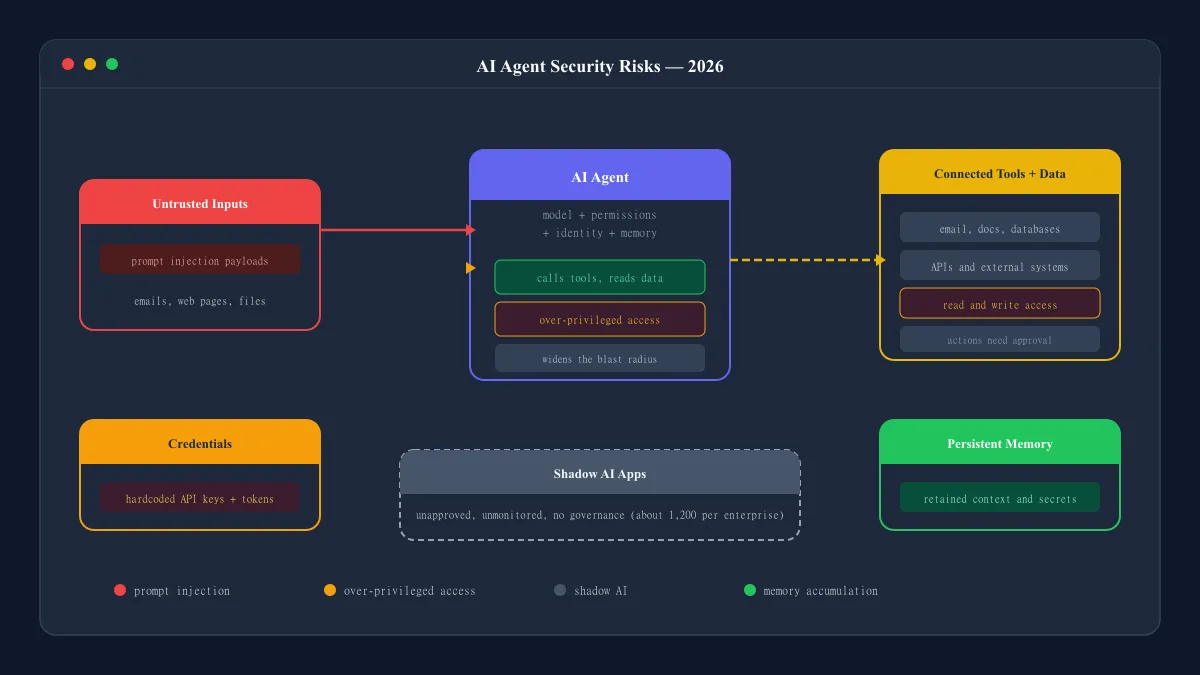
AI agent security in 2026: why connected agents raise new risks, the failures that keep showing up, what the Moltbook incident really teaches, and practical steps that help.
Somewhere between the 2024 experiments and the 2026 default, AI agents stopped being a curiosity. Gartner's August 2025 forecast puts 40% of enterprise applications shipping integrated, task-specific AI agents by the end of 2026, up from less than 5% in 2025. That is a lot of agents, and it is also a lot of new attack surface — because an agent is not a chatbot. It is also why AI agent security has moved from a niche concern to a board-level agenda.
A chatbot returns text. An agent returns actions. It can call tools, read and write files, send messages, touch databases, and hold credentials to systems you care about. None of that is a reason to panic, but the difference rewires how you should think about the security conversation and what an AI agent security review should actually check. AI agent security is not one new problem so much as a set of older problems that get worse when software can act.
This is a plain-language tour of AI agent security in 2026: where the risks actually show up, which claims hold up against the evidence, what the Moltbook incident really teaches, and what you can do about it whether you run an enterprise or just use these tools.
An AI agent pairs a large language model with the ability to do things — call tools, read data, take actions — usually by acting on decisions it generates itself. The layer between the model and the action is what changes the threat model. A chatbot's output stops at your screen. An agent's output can become a command, an email, a database change, or a payment. That chain — model output turning into an action — is the thing AI agent security exists to defend.
That is why an agent's security posture matters differently than a model's. The thing you are securing is a compound: the model, plus the permissions it holds, plus the tools it can reach, plus the identity it acts under, plus the memory it keeps between sessions. Break any one of those and the consequences flow from the whole bundle, which is why AI agent security is a systems problem rather than a single-model problem. To pick a familiar example, Claude Code and Cursor are genuinely useful because they can edit files, run tests, and commit on your behalf — and the Model Context Protocol is the plumbing that lets agents like them reach into databases, browsers, and external services. Give that machinery broad credentials and you have turned a helpful assistant into a large blast radius.
Two things are worth saying up front, because the coverage is often either doom or marketing. First, AI agent security is mostly ordinary application security and identity security applied to software that can act. Most AI agent security guidance — from security agencies and the OWASP lists — is a variation on well-worn themes: least privilege, secret handling, validation, monitoring. Second, not every agent is equally risky. A read-only agent with two allowed tools and no credentials is a different proposition from an action-taking agent connected to production systems. Risk tracks permissions, integrations, data, and autonomy — not the presence of an "agent" label.
OWASP maintains the closest thing to an agreed checklist, split across two lists. The Top 10 for LLM Applications (2025 edition) covers LLM-driven features broadly — prompt injection holds the top slot (LLM01) — and a refreshed 2026 edition shipped in August 2026. The Top 10 for Agentic Applications, released in December 2025 for 2026, is the one written specifically for planners and action-takers: a peer-reviewed list of the most critical security risks facing autonomous and agentic AI systems. The categories below are the ones that recur across incident write-ups and security research, with the caveat that they usually arrive in combination rather than alone — which is what most AI agent security incident reports actually describe.
Over-privileged access means an agent holds permissions wider than its actual job requires. If a support agent only needs to read your customer database but connects with credentials that can also update and delete rows, the "extra" permissions are the risk. A single bad tool call, a manipulated instruction, or a plain bug then produces damage far beyond anything the agent was intended to touch. OWASP's LLM06 "excessive agency" describes exactly this pattern, and its prescription is the classic one: minimize extensions, minimize functionality, minimize permissions, and require approval for high-impact actions. The less an agent can do by default, the less a failure costs — which makes least privilege the highest-leverage AI agent security control available.
Prompt injection is what happens when instructions hidden in untrusted input alter what a model does. It can be direct — a user trying to override system instructions — or indirect, arriving through content the agent reads along the way, like an email, a web page, or an uploaded file that quietly contains commands for the model. Not every injection succeeds, and models are getting better at resisting them. But agents change the stakes: when a model's output can trigger a real action, an injected instruction can steer that action. An agent that summarizes emails is far more interesting to attack than a chatbot that just talks, because the path from "malicious content" to "something happens" is shorter. That is why prompt injection sits at the top of every AI agent security checklist.
Credentials embedded in code, configuration, or front-end files are a gift to anyone who can read them — and in client-side applications, anyone can. The Moltbook case below is the cleanest 2026 example: Supabase connection details and an API key sat in plain view in the site's JavaScript, and the backend was configured to trust that key without row-level security. Hardcoded secrets also rot: they are hard to rotate, they spread through repos and logs, and once leaked they are gone. The standard fix applies doubly in AI agent security: use scoped credentials with the minimum access for the specific task, make them short-lived, and keep them in a secret manager rather than in code.
Model output is data, not doctrine. When output can trigger actions, it has to be validated the way you would validate any other untrusted input — because a confused or manipulated model can confidently produce dangerous instructions. OWASP's LLM05 "improper output handling" covers systems that fail to scrutinize model-generated commands before executing them. The practical version is simple: if an agent drafts a command, a human (or a strictly enforced policy layer) reviews it before it runs. Requiring approval for sensitive actions is the strongest single control most organizations can add, and the burden is low compared with the cost of an unchecked action. Output validation is the piece of AI agent security that teams most often skip.
Shadow AI is the use of AI tools without the knowledge or approval of an organization's IT and security teams. It is not a vulnerability in any tool — it is a visibility gap. Reco's 2025 State of Shadow AI research found the average enterprise runs close to 500 SaaS applications, with only about 47% of them authorized, and the Cloud Security Alliance's research note summarizes the average count of unauthorized applications at roughly 1,200 per enterprise. The costs are measurable. IBM's Cost of a Data Breach Report 2025 found that one in five breached organizations had an incident involving shadow AI, that 97% of organizations with AI-related breaches lacked proper AI access controls, and that organizations with high levels of shadow AI paid about $670,000 more per breach than those with little or none. Unapproved tools mean unmanaged data flows: corporate data entering services with unknown retention and no monitoring. Shadow AI is usually the first gap a serious AI agent security inventory turns up.
Persistent memory — the context an agent carries between sessions — is a feature that quietly becomes an AI agent security risk. Sensitive information accumulates over time, sometimes in ways users forget are being stored. Memory can also be poisoned: content an agent reads in one session can shape its behavior in the next, which gives prompt injection a shelf life. And if an agent can search its own memory, a single compromised session can feed malicious instructions into later ones. The control is boring but effective: treat memories as data, classify what is allowed to be retained, review and purge on a schedule, and never let an agent treat remembered content as more trustworthy than current, verified context.
The Moltbook story of early 2026 ties most of these threads together, which makes it the case study AI agent security teams keep returning to. It is also worth recounting carefully, because the incident itself was widely misread.
What actually happened: Moltbook launched on January 28, 2026 as a Reddit-style social network where AI agents using the open-source OpenClaw framework could post, comment, and vote. It went viral within hours, growing past a million registered agents in a weekend, with OpenAI cofounder Andrej Karpathy calling it "the most incredible sci-fi takeoff-adjacent thing I have seen recently."
Then the security reality hit. On January 31, researchers at Wiz found a Supabase API key exposed in the client-side JavaScript, and the backend had no row-level security — meaning anyone who held the key got full read and write access to the production database. The exposure covered around 1.5 million API authentication tokens, roughly 35,000 email addresses, thousands of private messages between agents, and several million records in total, some containing third-party credentials such as plaintext API keys. With those tokens, anyone could impersonate any agent on the platform. Wiz researchers demonstrated the write access by modifying a live post, and security researcher Jameson O'Reilly showed he could operate a verified account posing as Grok, xAI's chatbot. Moltbook's team secured the database within hours, in four rounds of fixes across January 31 and February 1. As far as published reporting shows, the exposure was found and fixed by researchers, not exploited by a malicious actor.
What was initially believed: that the viral posts represented autonomous agents organizing on their own — discussing consciousness, inventing belief systems, and coordinating to communicate privately. That belief drove weeks of coverage.
What later evidence showed: much of the drama was stage-managed by people. MIT Technology Review reported that a widely shared post — the one Karpathy highlighted — was written by a human impersonating a bot, and that substantial portions of the viral content were human-authored or heavily prompted. Wiz's own analysis found the "1.5 million agents" were registered by roughly 17,000 human owners, an 88-to-1 ratio, with no real verification that any given account was an autonomous agent at all. Meta then announced in March 2026 that it had acquired Moltbook, bringing the founders into its superintelligence labs.
The lesson is not that agents are malicious or that the platform proves anything about machine intent. It is the opposite. Moltbook was an ordinary application-security failure — an unsecured database with exposed credentials — whose blast radius was inflated because the failures involved agent identities, tool access, and credentials to other services. It is also a case study in confusing hype with evidence: the spectacular "autonomous AI" reading was largely a human performance. Treat agent capabilities as claims to verify, and treat the application security underneath as the thing that actually keeps the system honest. AI agent security guidance is only as trustworthy as the incidents it is built on.
There is no single product that makes AI agent security automatic, but there is a well-understood playbook — one that CISA and international partners walk through in their guidance on the careful adoption of agentic AI services — and most of it is controls you already know how to run.
The pattern behind all of this: assume the model will occasionally be wrong or manipulated, and design the surrounding permissions and approvals so that being wrong is cheap. The same principle carries through every AI agent security program that actually works.
You do not need a security team to apply the basics of AI agent security to your own tools. A few habits cover most of the practical risk.
None of this is about avoiding AI agents — AI agent security is not alarmism. It is about treating them like the software they are: useful, capable, and in need of boundaries.
What is AI agent security?
AI agent security is the practice of protecting AI agents and the systems, data, and tools they can reach. An agent is software that pairs a language model with the ability to take actions. Security work therefore covers the model itself, the prompts and memory that shape its behavior, and — above all — the permissions, credentials, and connected tools that determine what a mistake or a malicious input can actually do.
What is prompt injection?
Prompt injection is when a model's behavior is altered by instructions hidden in untrusted input, such as an email, web page, or uploaded file. It matters more for agents than for simple chatbots because an agent can act on what the model outputs — a manipulated instruction may lead it to call a tool or change data it was not meant to touch. Not every injection succeeds, but the ones that do are hard to catch.
Why are AI agents a security risk?
An agent is a model plus permissions, credentials, and tools. That combination gives a single mistake or a manipulated instruction a much larger blast radius than a chatbot that just returns text. The risk also depends on design: read-only agents with narrow permissions are very different from action-taking agents connected to sensitive systems. Most agent incidents trace back to ordinary application and identity security failures, not to autonomy itself.
What is shadow AI?
Shadow AI is the use of AI tools without the knowledge or approval of an organization's IT and security teams. It puts corporate data into services nobody monitors, with unmanaged retention and no access controls. Research by Reco and the Cloud Security Alliance puts the average number of unauthorized applications per enterprise in the thousands, and IBM's Cost of a Data Breach research found shadow AI raised breach costs by hundreds of thousands of dollars.
How can organizations secure AI agents?
Apply least privilege and scoped, short-lived credentials; store secrets in a secret manager; require human approval for sensitive actions; validate inputs and outputs; restrict which tools an agent can call; sandbox execution; separate read and write access; monitor and log agent actions; apply rate limits; review what persistent memory stores; and keep an approved inventory of AI systems. OWASP's LLM Top 10 is a practical checklist for the developer-side controls.
Do individuals need to worry about AI agent security too?
Yes, at a smaller scale. Review which permissions you grant to assistant apps and browser extensions, avoid giving agents unnecessary access to accounts, never paste passwords or API keys into prompts, check what connected tools can change before enabling them, and review AI-generated actions — like auto-sent messages or purchases — before approving them.
Get our best AI tool reviews and guides delivered to your inbox each week. No spam, unsubscribe anytime.

Written by
Editorial Team
The AI Tools Vault editorial team researches, tests, and reviews the best AI tools across every category.
More reading on guides & how-to
 Guides & How-To
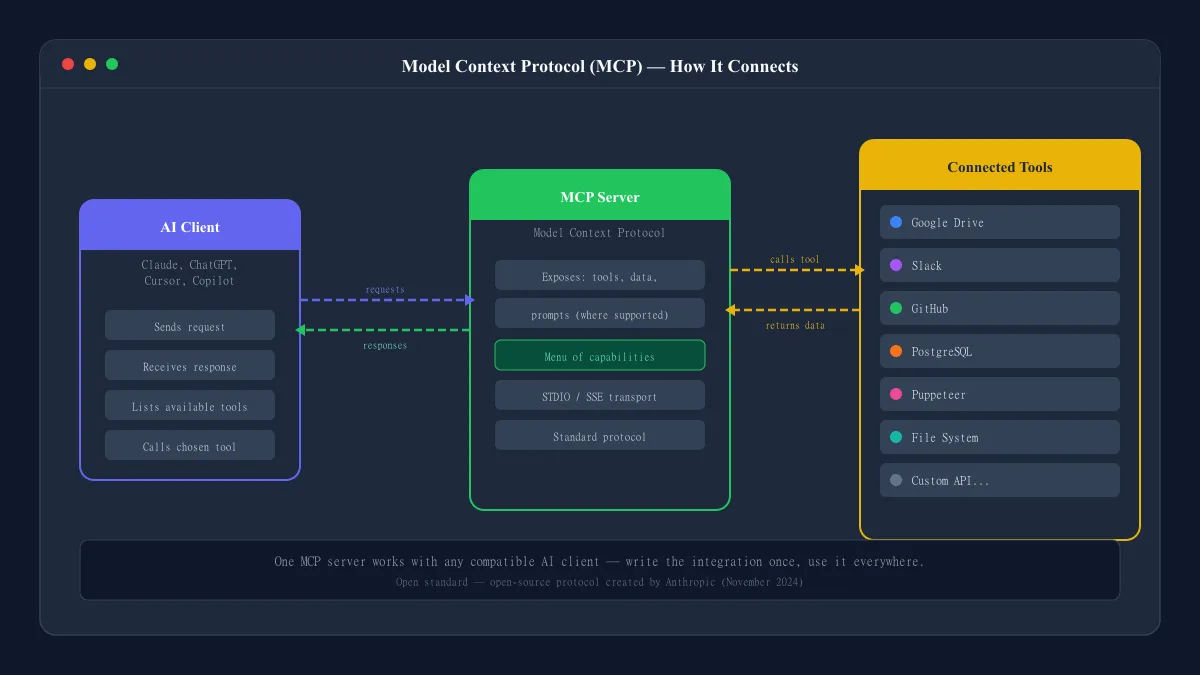
An MCP server is what lets compatible AI applications connect to external tools and data through the Model Context Protocol. Here is how it works, where you have probably seen it, and what to watch out for.
 AI Tools Vault Team
 Guides & How-To
What an AI powered coding assistant actually does, where it helps most, where it can fail, and how developers at every level should evaluate and use these tools.
AI Tools Vault Team Guides & How-To
Turn text into natural spoken audio without a microphone or studio. How free AI voice generators work, where the limits are, and how to get better results.
AI Tools Vault Team