AI for Google Sheets: Practical Guide for 2026
A practical guide to using AI with Google Sheets: writing formulas, cleaning and analyzing data, summarizing spreadsheets, and the security rules worth following.

A practical guide to using AI with Google Sheets: writing formulas, cleaning and analyzing data, summarizing spreadsheets, and the security rules worth following.
Spreadsheets get most of their value from the work you put into them: setting up the data, writing the formulas, and reading the results. AI for Google Sheets removes the slow parts of that loop, letting you describe what you want in plain language and get a working formula, a cleaned column, or a plain-English summary back almost instantly.
This guide explains what AI for Google Sheets can genuinely do in 2026, how the built-in Gemini features differ from add-ons and external tools, and where you still need to apply judgment. No feature is guaranteed to be in your account, so the plan requirements and limits are called out along the way.
Put simply, AI for Google Sheets means using a language model to help with the spreadsheet work you would otherwise do by hand. The model reads the data you point it at and produces something useful: a formula, a cleaned-up column, a summary, or a categorization.
There is an important distinction to keep straight. Google's own AI in Sheets is called Gemini in Sheets and is part of Google Workspace, not a separate spreadsheet program. Around that core sits a range of Google Sheets AI tools: third-party add-ons installed through the Workspace Marketplace, Apps Script projects that call AI APIs, and external chatbots like ChatGPT or the Gemini app that you feed data to outside the sheet.
Each approach has different capabilities, permissions, and privacy implications, which is why the rest of this article treats them separately.
Writing a formula is the most common reason people reach for AI for Google Sheets. Gemini in Sheets can generate formulas from a plain-English prompt and insert the result into the cell you choose. Instead of trying to remember IFS nesting, you can ask for the logic you actually want.
You can also paste a confusing formula into an add-on or an AI chat and get a plain-English explanation of what it does. That turns a spreadsheet built by someone else into something you can maintain. This is one of the most reliable uses of AI for Google Sheets because the input, the logic, and the output are all easy to verify.
Messy data is the enemy of every workbook. With AI for Google Sheets, you can trim inconsistent text, split or merge cells, standardize formatting, and flag duplicate entries without building long formulas. Gemini in Sheets can structure data into clean tables and point out inconsistencies, and the AI function can fill or extend a column based on the context of what is already there.
Given a range, AI can produce a short summary of what the data says. That is useful for a block of customer feedback, a list of survey answers, or a set of notes you want condensed. The AI function in Google Sheets can summarize an input cell or range in text directly inside a cell. Because it does not rearrange anything, summarization is a safe, read-only way to start with AI for Google Sheets.
Gemini in Sheets can answer questions about the numbers in your spreadsheet, identify trends, outliers, and key findings, and build charts and graphs. It can also analyze data across multiple tables in one tab, which helps when your answer lives in more than one place. For decision-makers, this is often where AI for Google Sheets pays for itself: it turns a static table into something you can interrogate.
Beyond summaries, AI can generate new text from the data in your sheet: a slogan from product keywords, an email draft from review scores, or a sentence describing each row. The AI function accepts a prompt and an optional range, then writes the result into cells for you. If your team produces the same text-shaped outputs week after week, this is a dependable AI for Google Sheets pattern.
Gemini can build and edit entire spreadsheets from a prompt, generating a new sheet or completing end-to-end tasks on an existing one. For heavier automation, Apps Script can call an AI API and run across many rows or on a schedule, which moves beyond one-off prompts into repeatable workflows. Automation may be the least obvious benefit of AI for Google Sheets until you build one recurring flow, after which it becomes hard to go back.
The way you use AI for Google Sheets generally falls into a few distinct patterns: results written into cells, results produced in a side panel, and results produced outside the sheet entirely. The right one depends on whether you want the output to live in your workbook and how sensitive the data is.
Open a spreadsheet and click Ask Gemini in the top right to open the side panel. From there you can create tables, write formulas, run analysis, and build charts. You can also start a formula by typing = and use the suggested shortcut, or use the AI function for cell-level output. This is the most direct way to use AI for Google Sheets, and it is the option most people mean by the phrase.
Access matters. Gemini in Sheets requires an eligible Google Workspace or Google AI plan. In practice, business accounts on Business Starter typically do not get Gemini in Sheets, while Business Standard and Plus, Enterprise Standard and Plus, and Google AI Pro and Ultra tiers do. Some features also require smart features to be enabled on your account, and availability varies by language and region. Check the official Workspace pricing page for what your plan includes.
Add-ons run inside the spreadsheet and give you formulas or a side panel on top of your data. GPT for Sheets and Docs exposes AI as spreadsheet functions you can drag down a column, and Excel Formula Bot generates and explains formulas for both Excel and Google Sheets. These install through the Google Workspace Marketplace and ask for permissions when you grant them access, so review exactly what each add-on can reach. For bulk, repetitive row work, this is often the most cost-effective AI for Google Sheets approach when you do not need Google's native plan.
If you want more control, Google Apps Script lets you write custom functions and automation that call an AI API. You can generate text for every row in a sheet, build a recurring report, or wire up a button that runs an AI step. This is the most powerful route and also the one with the most code to maintain.
You can also export a sheet or copy data into an external assistant like ChatGPT or the Gemini app, ask your question there, and paste the result back. It is flexible and requires no installation, but data leaves your spreadsheet, so it only makes sense for information you are comfortable sharing. This route to AI for Google Sheets works best for exploratory analysis rather than for confidential or production data.
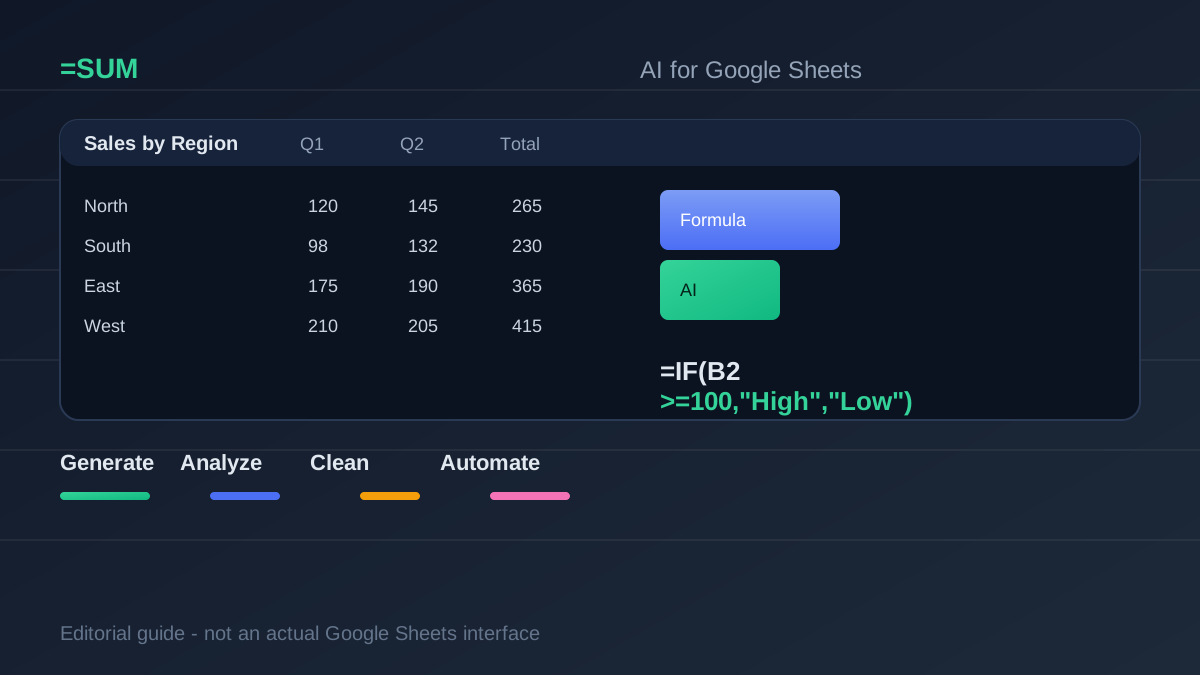
A quick example shows how the pieces fit together. Suppose a sheet tracks sales with a column for region and a column for amount.
=IF(B2>=100,"High","Low"), which you insert and then check against your own columns.=AI("Classify the customer feedback as a compliment, exchange request, or return request.", C2) generates a label for that row, and you can apply the same function down the column.=AI("Write a one-sentence summary of this feedback.", A2:D2) condenses several rows into a single takeaway you can paste into a report.Treat every output as a draft. A healthy habit with AI for Google Sheets is to read the generated result as a suggestion rather than a finished product. Verify cell references, ranges, criteria, date handling, and the business logic before a formula or classification touches anything that matters.
| Approach | Best for | Main advantage | Main limitation |
|---|---|---|---|
| Gemini in Sheets | Formula writing, analysis, charts, native workflow | No setup; works with your sheet in place | Requires an eligible plan; some features limited or experimental |
| AI add-on | In-sheet generation and bulk row work | Drag-down formulas and side panels | Third-party access and permission review needed |
| Apps Script + AI API | Custom, scheduled automation | Full control over the workflow | Requires coding and maintenance |
| External AI tool | One-off questions, big analysis | Flexible and familiar | Data leaves the spreadsheet |
None of these is universally best. Match the approach to how sensitive the data is and how often you run the task. Whatever structure you choose, the fundamentals of good AI for Google Sheets stay the same: precise prompts, verified output, and least-privilege data access.
The real benefit of AI for Google Sheets is speed plus a lower barrier to entry. People who never learned nested functions can now get a working formula, and teams can convert a messy dataset into a tidy, labeled table in minutes rather than hours.
The limits are just as real. AI can be wrong, sometimes confidently. It may reference the wrong cell, guess at a range, mishandle dates, or produce a classification that does not fit your business. The AI function is also limited in specific ways: its responses are text only, it does not see your entire spreadsheet or Drive, embedded AI functions are not supported, and there are per-month generation limits. For the built-in feature, Google documents the usage limits by plan, so heavy use can run into caps.
The rule is simple: AI drafts, humans decide. For totals, financial figures, and anything with real consequences, verify before you rely on it.
Using AI for Google Sheets with real spreadsheet data raises genuine privacy questions, and the answer depends almost entirely on which tool you use.
For Google's own Gemini in Sheets, review the official documentation on how prompts, generated content, and referenced Workspace content are handled. Whatever the details, treat the built-in feature as part of your Google Workspace account and its settings rather than as something with separate data guarantees.
Third-party add-ons send your data to their own servers. Before installing one, find out where the data goes, how it is processed, what is retained, and whether it is used for training. Never paste a password, API key, or other secret into any prompt or add-on. A spreadsheet that contains customer names, financial records, employee information, or internal pricing is not something to hand to an unknown service without checking its privacy policy.
Least privilege applies here too. If an add-on only needs one sheet, do not grant it access to your entire Drive. Review the OAuth permissions an add-on or Apps Script project requests, remove integrations you no longer use, and keep API credentials out of shared files. Google Sheets itself is not made unsafe by using AI; the risk comes from the sensitivity of the data, the permissions you grant, and the provider you choose. That balance is worth stating plainly rather than assuming any of it.
Practicing AI for Google Sheets is straightforward if you keep a few rules in mind.
If you are building automation as part of a larger workflow, the guidance in our guide to the best AI automation tools carries over to spreadsheets. Students and researchers can also pair these skills with the best AI tools for students and researchers, and small teams often get the most value once they connect their sheets to their wider AI tools for small business stack. Freelancers juggling multiple client workbooks may find the practical time savings well worth the setup, as covered in our best AI tools for freelancers roundup.
AI for Google Sheets is not a replacement for understanding your data; it is a way to get to that understanding faster. Start with one formula, one cleaned column, or one summary, verify the result, and expand from there. In 2026 the practical wins are real for teams that combine the right tool with a clear human review step.
What is AI for Google Sheets? AI for Google Sheets is the use of artificial intelligence to help with spreadsheet work inside Google Sheets. That includes writing and explaining formulas, cleaning and organizing data, summarizing ranges, analyzing numbers, and automating repetitive tasks. It can come from Google's built-in Gemini features or from third-party add-ons and external AI tools.
Can AI create formulas in Google Sheets? Yes. Gemini in Sheets can generate formulas from a plain-English prompt and insert them into a cell, and the AI function can write results directly in cells. Third-party formula generators produce a formula you then paste in. Always check cell references, ranges, and criteria because AI-generated formulas are not guaranteed to be correct. In practice this makes AI for Google Sheets a helpful formula assistant rather than a substitute for checking your own references.
Can AI analyze Google Sheets data? Yes. Gemini in Sheets can identify trends, outliers, and key findings, build charts, and answer questions about the data in your spreadsheet. Add-ons and external AI tools can also analyze data, but the quality depends on the tool, the data you provide, and your own verification of the results.
How can I use Gemini in Google Sheets? Open a spreadsheet, click Ask Gemini in the top right, and type a prompt such as a request to create a table or a question about your data. In eligible cells you can also write the AI function, for example =AI("summarize this feedback", A2:D2). Access requires an eligible Google Workspace or Google AI plan, and some features need smart features enabled.
Is it safe to use AI with Google Sheets data? It depends on the tool and the data. Never paste passwords, API keys, or other secrets into a prompt. Understand where a third-party add-on sends your data, its retention policy, and the permissions it asks for, and give tools only the access they need. For Google's own Gemini features, review the official documentation on how your content is used.
Can AI automate repetitive Google Sheets tasks? Yes, in several ways. Gemini can build and edit entire spreadsheets from a prompt and fill cells based on context, the AI function can generate and categorize across many cells, and Apps Script can pull in an AI API to run on a schedule. Automation still needs review when it affects important decisions or sensitive data. For teams that rely on repeatable reporting, AI for Google Sheets can remove a meaningful chunk of the manual assembly.
Get our best AI tool reviews and guides delivered to your inbox each week. No spam, unsubscribe anytime.

Written by
Editorial Team
The AI Tools Vault editorial team researches, tests, and reviews the best AI tools across every category.
More reading on guides & how-to
 Guides & How-To
The best AI tools for Etsy sellers in 2026 cover keyword research, product descriptions, photos, and shop automation. Here is how seven verified tools fit together, what each one costs, and where they fall short.
 AI Tools Vault Team
 Guides & How-To
AI browser agents plan and execute multi-step tasks in a real browser — researching, filling forms, and booking. Here is how they work, what they can do, and how to stay safe in 2026.
AI Tools Vault Team Guides & How-To
The AI tools for job seekers actually worth using in 2026 — practical steps for tailoring resumes, practicing interviews, and tracking applications.
AI Tools Vault Team