
Free Stable Diffusion AI Image Generator
Image GenerationFreemiumStable Diffusion is the free open-source AI image generator that runs locally or online, no sign-up required for basic use.
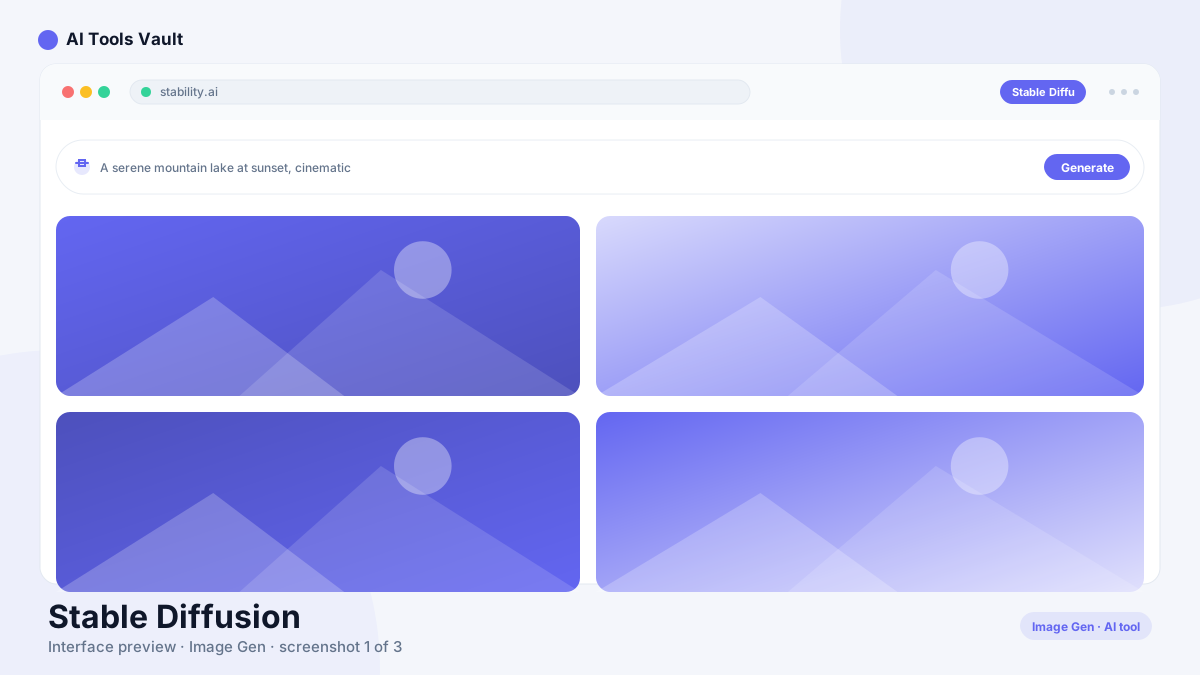
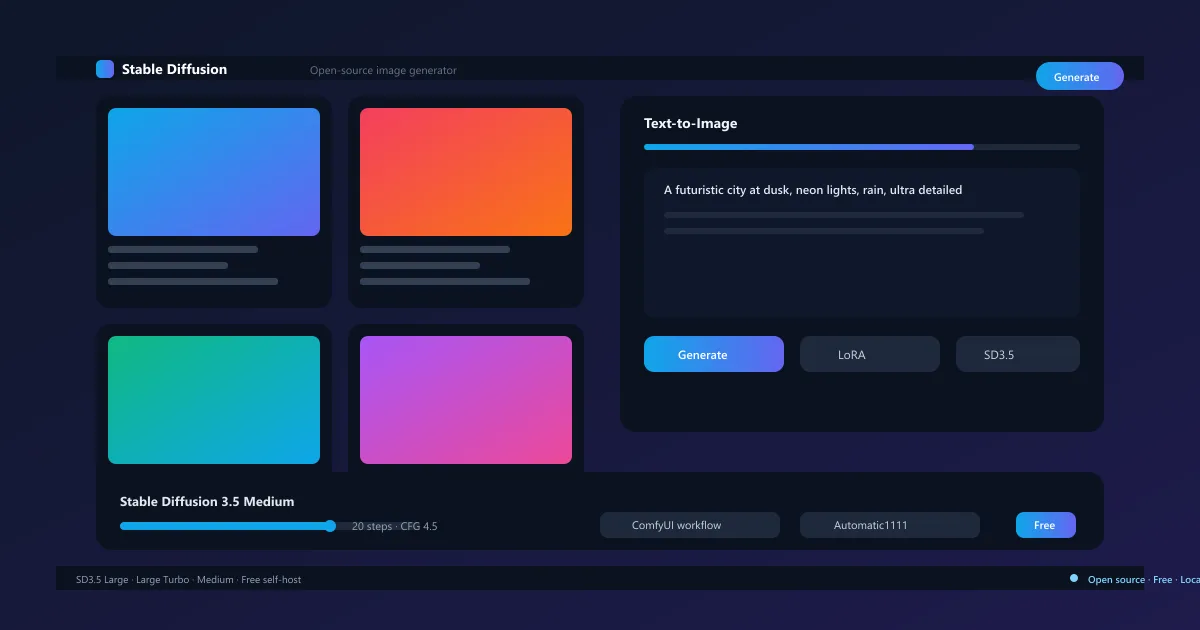
What Is Stable Diffusion?
- Open source and free to use
- Run locally on your GPU or online in a browser
- No sign-up required for basic free use
- Create anime art, realistic portraits, concept art and game assets
Stable Diffusion Prompt Generator — Text to Image
- "a misty mountain landscape at sunrise, cinematic lighting, volumetric fog, highly detailed, 8k"
- "a portrait of an astronaut in a neon-lit cockpit, dramatic rim light, ultra detailed"
- Tune CFG scale, steps, and sampler in the UI for finer control
- Negative prompts remove unwanted objects and distortions
Stable Diffusion XL (SDXL) and Img2Img
- SDXL — newer model with better quality and prompt understanding
- Img2Img — redraw an existing image from a prompt
- Background remover — clear the backdrop in one click
- Outpainting — extend scenes beyond the original frame
Stable Diffusion Upscaler & Inpainting Tools
- Upscaler — sharpen and enlarge any generated image
- Inpainting — redraw only the masked region
- Outpainting — extend the canvas in any direction
- Combined they deliver finished, print-ready art
Stable Diffusion ControlNet & LoRA Models
- ControlNet — pose, depth, edge and sketch control
- LoRA — add styles and characters to any checkpoint
- Checkpoints on Civitai extend the style range
- Anime and realistic art styles both supported
Anime and Realistic AI Art Styles
- Anime checkpoints — clean line work and cel shading
- Realistic checkpoints — skin texture and natural light
- Cyberpunk and sci-fi LoRAs for concept art
- Game dev assets — consistent characters and props
Fixing Bad AI Hands and Anatomy
- Inpaint the hand region and regenerate
- Use ControlNet pose to lock the skeleton
- Raise CFG scale and step count for cleaner anatomy
- Negative prompts remove extra fingers and limbs
Stable Diffusion Pricing — Free vs Paid Options
Compare Plans & Pricing
Open source & free to self-host; free web apps with no sign-up; Stability AI API from ~$0.035/image; Enterprise license above $1M revenue
Self-hosted
Download the open weights and run Stable Diffusion locally.
- Unlimited free generations
- Full privacy & offline use
- Custom models, LoRAs & checkpoints
- ComfyUI & Automatic1111 support
API (pay-as-you-go)
Credits at $10 per 1,000; paid per successful image.
- SD 3.5 Medium ~3.5 credits
- SD 3.5 Large Turbo ~4 credits
- SD 3.5 Large ~6.5 credits
- No subscription required
Enterprise
Required for commercial use above $1M annual revenue.
- Commercial licensing
- Priority support
- Volume pricing
- Custom deployments
Stable Diffusion vs Midjourney
Pros and Cons
Pros
- Completely free to self-host with unlimited generations
- Free online apps work without sign-up
- Open weights enable custom fine-tuning and LoRAs
- SDXL and SD3.5 versions offer strong image quality
- Full privacy — runs locally on your hardware
Cons
- Requires a capable GPU for local use
- Base model quality trails top commercial tools
- Prompt engineering has a learning curve
- Commercial use above $1M revenue needs a license
Best For
Recommended use cases and scenarios where Stable Diffusion shines.
Frequently Asked Questions
Common questions about Stable Diffusion, answered.
Is Stable Diffusion really free?
Yes. The model weights are open source and free to download, and you can generate unlimited images locally on your own GPU. Many online web apps are also free, with no sign-up required for basic use.
Do I need a powerful GPU to use Stable Diffusion?
For local use, a GPU with around 8GB of VRAM runs SDXL reasonably. If you do not have one, use a free online web app that hosts the model for you — no sign-up needed for basic use.
What is the difference between Stable Diffusion and SDXL?
SDXL is the newer, more powerful model version. It generates higher-resolution images with better detail and understands prompts far better than the original 1.5 checkpoints.
What are Img2Img, inpainting, and outpainting?
Img2Img redraws an uploaded image from a prompt, inpainting regenerates only a masked region to fix details like hands, and outpainting extends an image beyond its borders. A background remover clears backdrops in one click.
Is Stable Diffusion better than Midjourney?
For out-of-the-box aesthetic quality, Midjourney is usually better. This one wins on cost (free), privacy (local), and control (fine-tuning, ControlNet, LoRAs, custom checkpoints). Many creators use both.
Reviews & Ratings
Loading reviews...
Explore More Image Generation Tools
Browse the full AI Tools Vault directory to compare Stable Diffusion with every image generation tool, or line up your shortlist side by side.
Similar Tools
More Image Generation tools you might like

Midjourney
Midjourney AI is the industry-leading text-to-image generator behind the V8.2 model, known for stunning artistic and photorealistic outputs.

Craiyon
Craiyon is a free AI image generator — formerly DALL·E mini — that turns text prompts into 9 image variations in seconds, with no account required.

Guides & Articles about Stable Diffusion
Read our detailed reviews and comparisons covering Stable Diffusion
 Guides & How-To
How to Turn Sketches Into Art with AI in 2026
Turn rough sketches into finished art with AI in 2026 — AutoDraw for instant cleanup, Scribble Diffusion for sketch-to-image, and ControlNet-style tools for full control over the result.
 AI Tools Vault Team
 Guides & How-To
Best Free AI Image Generators in 2026 (Tested)
The best free AI image generators of 2026 tested — FLUX.1, ImageFX, Ideogram, Leonardo and DALL·E for free image generation, plus Pixlr for editing what you make.
AI Tools Vault Team Guides & How-To
Best Free AI Tools for Removing Backgrounds and Editing Photos in 2026
The best free AI tools for removing backgrounds and editing photos in 2026 — Remove.bg, Photoroom, and Stable Diffusion, tested and compared.
AI Tools Vault Team