Generative AI Invoice Reconciliation Software: How It Works
Invoice reconciliation is really several different workflows. Learn the difference, what generative AI can and cannot automate in each, and how to test a tool before you buy.

Invoice reconciliation is really several different workflows. Learn the difference, what generative AI can and cannot automate in each, and how to test a tool before you buy.
If you search for "generative AI invoice reconciliation software," you get a wall of vendors promising to eliminate your entire accounts payable team. The problem is that the term quietly covers several very different jobs, and most of the products on that search results page are only actually good at one of them.
One tool is great at reading a messy PDF invoice and turning it into clean line items. Another is great at checking thousands of invoices against purchase orders. A third is built to match payments to invoices when a bank is involved. A fourth reconciles AP to your ERP at month end. They all call themselves AI reconciliation software.
So before you evaluate a single product, you need to answer a question most demos will not ask you: which reconciliation workflow do you actually have? Answer that first and the buying decision gets much easier. This guide walks through the distinct workflows, the technology that actually sits behind the "generative AI" label, what current tools document about themselves, and how to test any of them on your own data before you pay.
A reconciliation is a comparison between two records that are supposed to agree, with the goal of finding, explaining, and clearing every difference. "Invoice reconciliation" is the umbrella term for the versions of that comparison that revolve around invoices. Here are the ones that genuinely matter in practice.
The invoice is compared against the purchase order that authorized the purchase. Header-level checks typically cover vendor name, currency, and total; line-level checks cover item description, quantity, and price. A two-way match catches "we never ordered that" and basic pricing errors, but it cannot tell you whether the goods actually arrived.
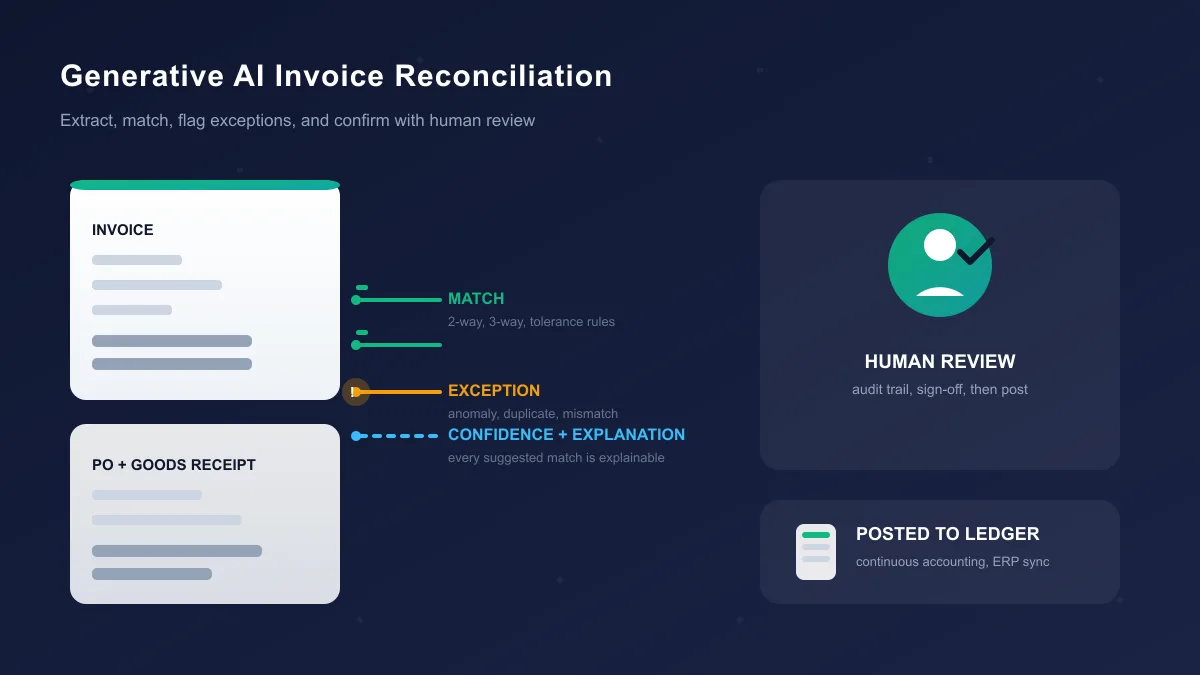
This is the standard control for PO-based purchasing. The system compares the supplier invoice, the purchase order, and the goods receipt note — checking that what you ordered, received, and were invoiced for agrees on quantity, price, and totals. HighRadius, for example, defines it exactly that way: "2-way matching verifies the invoice against the PO. 3-way matching adds a third document: the goods receipt (GRN)." Most enterprise AP automation platforms lead with this workflow, because it is where duplicate-paying, over-billing, and quantity disputes actually live.
Every supplier sends a statement listing the invoices, credit notes, and payments they believe are outstanding. Reconciling it means taking that statement and checking each line against your own records: which invoices are still open, which payments they missed, which credit notes you never received, and which of their line items duplicate something already paid. Supplier statements are how missing invoices and unapplied credits surface, which is why this workflow matters in large AP departments.
This is the other side of the coin, and there are two distinct versions. On the payable side, you compare the payments you issued against the invoices they were meant to clear, and flag any payment that clears the wrong invoice or no invoice at all. On the receivable side, it is called cash application: matching customer payments (often received as bank lines with cryptic remittance info) back to the open invoices they pay. Both are really the same logical problem viewed from opposite ends of the ledger.
Aggregate, split, and partial payments break naive matching. A customer pays $10,000 against five invoices of $2,000 each with a single bank line. A supplier credits three invoices with one credit note. A payment covers part of an invoice because of a deduction. Systems that only match one-to-one will fail on these cases; the useful ones handle one-to-many, many-to-one, and true split matches, and they expose them in the review queue when they go wrong.
Duplicate invoices (same number, different amount), invoices for closed POs, line items priced far above contract, duplicate payments, and suspicious vendor changes are all exceptions. Some products treat these as a special class: they run separate detection on top of normal matching, flag anomalies, and hand them to the fraud or audit team rather than to the daily AP queue. This is where anomaly-detection models and "agents" add the most new value over older rule-based systems.
Finally, the broad version: reconciling subledger and bank data at month-end close, checking that everything posted balances, and documenting reconciling items for auditors. This is account reconciliation and it usually involves invoices only indirectly — invoices already posted feed the subledger, and the reconciliation compares that subledger to the bank and general ledger. If your problem is "our balance sheet reconciliations take three weeks," you are buying a different category than someone who just wants invoice-to-PO matching.
The point of walking through these seven is practical. Match a vendor's demo to your own workflow by name. A tool built for three-way matching will not fix your one-to-many cash application problem, and a bank-reconciliation platform will not run your three-way match. The tools listed later are grouped by these workflows for exactly that reason.
Vendors use "AI" loosely. Before comparing products, it helps to separate the actual techniques, because they have very different failure modes and audit implications.
OCR and intelligent document processing turn scanned invoices and statements into text and fields. This is a reading problem, not a reasoning problem, and it fails on handwriting, rotated scans, and novel layouts.
Deterministic rules are exact, auditable logic: "clear the invoice only if reference, amount, and due date all match." They never hallucinate, but they generate exceptions for every minor variance.
Fuzzy matching uses string and numeric similarity to accept near-matches: "Apple Inc." against "APPLE INC," or $1,249.99 against $1,250.00 within a tolerance. ReconArt, for instance, documents string-similarity fuzzy matching with user-configurable confidence thresholds and weighted match keys.
Machine learning models learn patterns from your history — which GL codes a repetitive vendor should get, which invoices usually match, which payment patterns look like fraud. HighRadius describes ML models and GenAI both being used for capture and matching; Ramp describes agents that learn coding behavior from past invoices.
Embeddings put text and structure into a vector space so semantically similar records can be compared. They are the mechanism behind a lot of intelligent matching and retrieval tools, and they are also probabilistic.
Generative AI and large language models read unstructured content, extract fields from messy layouts, summarize why a match failed, draft a reply to a supplier, classify an invoice as PO or non-PO, and answer questions about your data in plain language. Basware's InvoiceAI is explicit about this: it "leverages generative AI, AI agents, natural language processing and deep learning" across the invoice lifecycle from ingestion to reconciliation. Microsoft's Financial Reconciliation agent specifically uses generative AI to analyze matching results and write a summary with insights.
Agentic AI (and the looser marketing word "agents") means a system that plans and executes several steps across tools: capture an invoice, code it, match it, route an exception, draft an email, post to the ERP. BlackLine's Verity Prepare is described as a multi-agent system that analyzes supporting documents, matches transactions, identifies reconciling items, and assembles audit-ready reconciliations. Tipalti documents AI agents for invoice capture, PO matching, invoice scanning, tax-form scanning, ERP sync, reporting, and bill approvals.
RPA robots click through interfaces. RPA articles keep getting "AI" retrofitted to them, but robots that replicate clicks do not reason or read.
Here is the pattern that matters for buyers. In almost no product is "generative AI" the matching engine itself. Matching is usually deterministic rules plus fuzzy matching plus ML, because exact arithmetic should not be left to a probabilistic model. The generative layer sits around the edges: extracting fields from ugly documents, writing explanations of exceptions, summarizing review queues, and handling natural-language questions. That is a useful mental model, and it changes what you should test: ask the vendor which layer does what, and verify each layer separately on your own data. For a broader look at how agents fit into business operations, our guide to AI agents for business covers the pattern in depth.
Everything below is based on what each vendor's own materials state, checked on September 22, 2026. None of these products are ranked or scored, and nothing here is a substitute for testing on your own data. The claim is not that these are the only tools — it is that these are representative, real ones whose documented behavior is worth comparing.
HighRadius targets mid-market and enterprise AP. Its invoice matching software documents automatic two-way and three-way line-item matching against PO and goods-receipt data imported from ERPs, with variance checks on price, quantity, freight, and tax, configurable tolerance rules, and exception routing. It reports a 90 percent PO-invoice auto-match rate and 95 percent invoice capture accuracy — its own figures, published on its product pages, not something we have verified. HighRadius has described shifting to outcome-based pricing (no subscription and fees tied to agreed KPIs), so expect the deal structure to be custom and quoted.
Tipalti sells full AP automation: invoice capture and GL coding, two- and three-way PO matching, approvals, payments, and reconciliation back into your ERP. Its own site describes AI agents for invoice capture and PO matching plus an AI Assistant. Published pricing starts at CAD 139 per month for AP Automation with unlimited users, and transaction fees apply per invoice and per payment; that figure was on Tipalti's Canada pricing page when we checked.
Basware built its InvoiceAI on an e-invoicing network and documents both generative AI and AI agents. Its matching toolchain includes SmartPDF for converting PDFs into structured data, an AP Matching Agent that explains matching failures and suggests next actions, Guardian for AP to flag missing or invalid PO data, and statement matching as a separate product. Like most network vendors, it is quote-based — public pricing was not verified.
Ramp (Bill Pay) is smaller-scale, positioned for growing companies and small business. It documents 99 percent OCR accuracy on invoice capture, two-way and three-way matching, fraud and over-billing checks, and AI agents that learn coding behavior from your history. Ramp publishes a free plan that includes OCR capture, basic approvals, and ACH, card, and check payments, with paid plans on top. Its matching claims should be read as marketing — 99 percent OCR accuracy is a vendor-reported figure.
Vic.ai is an AI-first AP platform that processes invoices end-to-end with machine learning and confidence scores, routing high-confidence invoices toward payment and flagging the rest for review. We reviewed it separately; see our Vic.ai review for the full detail, including pricing notes.
GEP (Quantum Intelligence) documents an agentic layer for invoice management: a Reconciliation Agent that aligns invoices to POs, contracts, and receipts, and an Anomaly Detection Agent for duplicate and mismatch detection, with multi-way matching and exception routing to buyers. Pricing is custom and quoted — public pricing was not verified.
Cointab is a reconciliation-automation platform that formalizes the two-sided comparison as "Side A versus Side B" and documents a matching engine with rule-based, fuzzy, and subset-sum algorithms — the last one being how the one-payment-clears-multiple-invoices case gets solved. It claims SOC 2 Type II and ISO 27001 compliance on its own site. Cointab publishes tiered monthly plans, but the figures have differed between page versions we checked, so confirm the current price on the site.
Procuros is in the B2B food and grocery trade network space rather than generic AP. One product reconciles retailer payments to supplier invoices for suppliers (flagging underpayments and deductions); another performs AI-assisted three-way matching of invoices, POs, and goods receipts for retailers. Quotes and pricing are behind a demo — public pricing was not verified.
FlowParse is a document-extraction product with a reconciliation angle: it reads invoice PDFs (including scans), validates the fields against each other, and exports to Excel, CSV, JSON, Xero, and other formats, and its API includes a reconcile endpoint that matches invoices to bank payments. A free tier covers 10 pages a month; the company states GDPR compliance.
InvoiceHive pairs invoice extraction with bank-statement parsing (including MT940 bank files): it extracts invoices and bank lines, flags anomalies such as duplicates and mismatches, matches with confidence scores, and keeps payables, receivables, and bank lines in one review workflow. It offers a free way to start; paid tiers appear to be sold through the product, and public pricing was not independently verified.
BlackLine is the record-to-report platform. Its Verity Prepare agent automates reconciliation preparation — gathering supporting documents, matching transactions, and identifying reconciling items — and BlackLine says it keeps explainability and human control in place. Verity AI also includes generative-AI summarization; BlackLine states this generation uses its own secure infrastructure and does not train generalized models on customer data, and that any custom ML models are trained only with explicit permission. Pricing is custom and quoted — public pricing was not verified.
ReconArt covers bank, credit card, and AP/AR reconciliation, intercompany, and the month-end close. It documents fuzzy matching with configurable confidence thresholds and weighted match keys, and an AI Assistant that lets users create matching rules in natural language and that explains its own logic. Licensing is edition-based with no list price published — public pricing was not verified.
Microsoft ships a Financial Reconciliation agent inside Copilot for Finance (documented on Microsoft Learn). You upload two datasets, typically two Excel workbooks — one side an SAP balance, the other a bank or subledger — and the agent suggests reconciliation vectors, classifies the output into unmatched and potentially matched groups, explains in plain language why items remain unmatched, and generates a summary. It runs in assistive or autonomous modes and logs traceability IDs for every aggregation and reconciliation step. This is a genuine example of generative AI performing a reconciliation workflow end to end, which is why it is worth studying even if you do not use the Microsoft stack.
Two patterns stand out across all of these. First, every serious tool keeps a human review step with an audit trail; autonomy is about shrinking the review queue, not removing it. Second, the matching engines are a mix of rules, fuzzy logic, and ML, with generative AI handling extraction, explanation, and exception handling. If a demo is vague about which layer does what, that is itself a data point.
Every product that auto-clears invoices does so through some combination of a tolerance window and a confidence threshold. Tolerances say how far a value can drift — 0.5 percent on amount, one unit on quantity, seven days on date. Confidence says how sure the system is that two records refer to the same economic event.
The failure modes live in the boundary between the two. A wide tolerance auto-clears quiet fraud: a 1 percent over-billing on a 100,000-invoice book is invisible per invoice and real in aggregate. A strict tolerance drowns the team in false-flag exceptions. And confidence scores from ML models are only meaningful if they are calibrated against your own population — a vendor's 98 percent accuracy on their benchmark data tells you almost nothing about your invoice mix.
This is why explainability is not a nice-to-have; it is the audit interface. Microsoft's agent explains why an item is unmatched by showing related transactions. Basware's AP Matching Agent explains matching failures and links to the customer's own rules. ReconArt lets you write rules and then see the logic applied. BlackLine's Verity framing is literally "transparent reasoning plus human oversight." When you evaluate a tool, generate an anomaly and ask the vendor to walk you through the tool's explanation for it. If the answer is a score with no explanation, escalate: your auditor will ask the same question.
If your team is still doing this in spreadsheets while you evaluate, our guide to AI for Google Sheets is a practical way to prototype matching logic before committing to a platform.
A short warning first: this is a recommended evaluation methodology, not a report of tests we ran. We have not evaluated any of the products above and cannot vouch for how they perform on your data. Run the comparison yourself.
The controlled test has a simple shape: build a golden file on your own data, let the tool chew through it, and compare every decision the tool makes against the human-known truth.
Step 1. Pick a single workflow and a single legal entity. Do not test three workflows at once — you will learn nothing.
Step 2. Export three to six months of real data: invoices, POs and goods receipts (if relevant), bank or payment statements, and any exception reports. Real data matters because your quirks are the point.
Step 3. Build the golden file by hand: for every line, a person decides "match," "exception," or "needs review." This is the ground truth your tool will be measured against. On 500 to 1,000 records it takes a few hours and it is the most valuable hour of the whole evaluation.
Step 4. Seed known edge cases deliberately. The composition sample below is a design target for your set, not a measurement.
| Category | Share of test set | What it is |
|---|---|---|
| Clean one-to-one matches | ~70% | Identical references, clear amounts, easy |
| Near-matches | ~10% | Whitespace, case, and abbreviation differences (Acme vs ACME Inc.) |
| Genuine exceptions | ~6% | Wrong amount, wrong date, duplicate line, closed vendor, exceeded PO |
| One-to-many | ~5% | One payment or credit note clears several invoices |
| Many-to-one | ~4% | Several payments settle a single invoice |
| Fraud-relevant | ~3% | Same reference, different amount; duplicated invoice number, changed bank details |
| Unstructured | ~2% | Missing references that legitimately require human review |
Step 5. Define your three headline metrics before the tool runs: exact-match rate (of true matches, how many were auto-cleared), false-flag rate (how many clean records were wrongly sent to review), and missed-exception rate (how many true exceptions were auto-cleared — the dangerous number).
Step 6. Run the tool on the same dataset and export every decision it made, including the ones it auto-processed. Count your three metrics yourself. Do not accept the vendor's dashboard averages.
Step 7. Check the explanations. For fifty matches the tool got right and the exceptions it flagged, ask it to show the reasoning, then read the reasoning your team wrote by hand and compare.
Step 8. Leave the tool in read-only mode for two weeks while your team keeps doing the real work. Compare decisions daily. This parallel run is where operating problems surface: noisy exports, slow routing, approval chains that fight your existing process.
Step 9. Only after the two weeks, switch on auto-posting for the audited subset — the workflow you chose in step 1 — and keep everything else manual.
Step 10. Test the exit. Export everything the system holds, including documents and audit log, and check nothing is trapped in a proprietary format that your ERP cannot import.
Step 11. Ask the vendor to walk through one anomaly end-to-end before you sign: from bank line to flagged exception to reviewed disposition in your audit trail. If this demo does not happen live, that is the answer.
If the tool cannot survive step 6 through step 11 on your data, the demo metrics are irrelevant. A two-week, single-workflow test is also the standard way to avoid the rollout anti-pattern where a "better" tool just makes a broken process faster — something we discuss in our roundup of the best AI automation tools.
Duplicate payments and duplicate invoices are the classic AP fraud and error pattern, and the strongest argument for anomaly detection that runs on top of ordinary matching. The signals are well known: an invoice number that already exists in the system with a different amount, a vendor record edited right before a payout, a payment that clears a closed PO, an amount that spikes outside a vendor's normal range, bank details changed weeks before a large payment. Ramp documents duplicate-invoice monitoring and over-billing checks in its Bill Pay fraud suite. GEP documents an Anomaly Detection Agent for duplicates and mismatches. HighRadius markets real-time anomaly detection across its financial close products. Tipalti includes fraud detection in its platform controls.
The generative layer here is useful but must be positioned honestly. An LLM can read a flagged anomaly and write a coherent one-paragraph summary of why it is suspicious — which is genuinely useful for routing it to the right person. What it cannot do is certify that a payment is fraudulent. An explanation is a decision aid, not evidence. Keep the fraud decision with a human investigator, and treat the model's summary as the first draft of the case file rather than the conclusion. For more on the governance side of letting AI agents act on financial data, our AI agent security guide is worth reading before you give any tool posting rights.
You are going to upload invoices containing bank details, tax IDs, and sometimes contracts. Before you do, get precise answers to these questions, and ask for them in writing:
The certification language above is vendor-reported; verify the certificate and scope with the vendor or the certifying body before relying on it.
The realistic cost picture is a subscription plus variable fees, and the variable part is where budget surprises hide.
Tipalti's published example is instructive: CAD 139 per month for AP Automation with unlimited users, plus transaction pricing per invoice and per payment. A company processing 5,000 invoices a month is paying a very different total than a company processing 50,000. HighRadius has announced outcome-based pricing with custom KPIs. Basware, GEP, BlackLine, and ReconArt quote per-organization, and we were unable to verify public pricing for them. Cointab lists monthly tiers on its site, though the quoted figures have changed between page versions, so confirm the current number. Ramp publishes a free Bill Pay tier and paid plans; FlowParse offers 10 free pages a month; InvoiceHive offers a free way to start.
Implementation is a real line in the budget: cleaning vendor master data, wiring bank feeds, mapping GL codes, and defining the tolerance rules that turn the tool on. Vendors quote "time to value" in weeks; on real data, a single-entity workflow takes weeks, and enterprise multi-entity rollouts take quarters.
Every vendor publishes impressive outcome numbers — BlackLine reports early adopters cutting up to 92 percent of manual reconciliation preparation time, Basware cites over 200 hours a year saved on manual non-PO invoice processing, HighRadius reports a 90 percent PO-invoice auto-match rate, and Ramp reports 99 percent OCR accuracy. Treat all of these as vendor-reported marketing outcomes from their customer base, not as predictions for your environment. The honest ROI math is simple: count the hours your team spends today on that workflow, apply the reduction the tool achieves on your golden file, and price that against the subscription plus implementation. If you do not know the before number, buy nothing yet. For small businesses comparing these platforms against simpler options, our AI tools for small business guide has a wider frame for the decision.
Small teams can prototype the whole idea cheaply. A spreadsheets-meets-AI setup (see our AI for Google Sheets guide), a bookkeeping matcher like Booke AI inside QuickBooks or Xero, or a lightweight AP platform is enough to feel the difference before any enterprise purchase. The category change from "bookkeeping help" to "enterprise reconciliation platform" is worth thousands of dollars, so test before you climb the ladder.
What is generative AI invoice reconciliation software?
Software that uses AI to compare invoices against other records — purchase orders, goods receipts, bank or payment statements, or general ledger entries — and to prepare that comparison for human review. Most products combine several techniques: OCR to read documents, rules and fuzzy matching or machine learning to find matches, and generative AI models to extract messy data, draft exceptions, and explain why a match did or did not happen.
Is invoice reconciliation one workflow or several?
It is several. Common ones include two-way matching (invoice against purchase order), three-way matching (invoice, PO, and goods receipt), invoice-to-payment reconciliation, vendor statement reconciliation, matching one payment that clears many invoices, exception and anomaly detection, and broader transaction or account reconciliation at month-end close. Different tools target different workflows, so the first buying decision is which one you actually have.
How is generative AI different from OCR and rule-based matching?
OCR turns a scanned document into text. Rule-based matching applies fixed logic such as "reference number equals amount equals date." Generative AI models can read poorly structured data, summarize context, explain exceptions in plain language, and answer questions, but they are probabilistic. In practice vendors combine all of these: deterministic rules for what must be exact, fuzzy matching and machine learning for what is close, and generative AI for extraction, explanation, and exception handling.
What is a three-way match?
A three-way match compares three documents before payment: the supplier invoice, the purchase order, and the goods receipt note. The system checks that what you ordered, received, and were invoiced for agree on quantity, price, and totals. It is the standard control for PO-based purchasing and it is where most automated invoice matching claims are focused.
Can generative AI match invoices without human review?
For clean, high-confidence cases, yes — vendors will auto-match invoices that fall inside tolerance rules. For anything else, no. Finance teams still review exceptions and low-confidence matches, and audit standards generally require evidence of that review. The useful question is not whether AI replaces review but how small the review queue becomes and whether the tool can explain what it did for each line that reaches a person.
How should we test these tools before we buy?
Run a controlled test on your own data: pull a few months of real invoices and statements, build a golden file where a human has decided each line is a match, an exception, or needs review, and seed known edge cases like duplicates, partial payments, and one-to-many payments. Compare the tool's decisions against that file, count false flags and missed exceptions, and check that every suggested match has an explanation you can follow. A two-week parallel run on one workflow is enough to learn whether a tool fits.
The rule that decides whether generative AI invoice reconciliation software is worth buying has not changed: match the tool to the workflow, verify it on your own data, and keep a human attached to every line that matters. The vendors change, the models change, the workflow taxonomy does not. Start there, and the rest of the evaluation writes itself.
Get our best AI tool reviews and guides delivered to your inbox each week. No spam, unsubscribe anytime.

Written by
Editorial Team
The AI Tools Vault editorial team researches, tests, and reviews the best AI tools across every category.
More reading on guides & how-to
 Guides & How-To
A practical guide to AI tools for sales teams in 2026: which sales jobs AI can actually take over, how to pick tools without a messy stack, and what still needs a human.
 AI Tools Vault Team
 Guides & How-To
What an AI calculator online actually is, how it differs from a normal calculator and a math solver, how accurate these tools are, and how to verify their answers.
AI Tools Vault Team Guides & How-To
AI tools for Outlook troubleshooting help you diagnose why Copilot is missing, add-ins won't load, or browser extensions disappear. Practical fixes for Outlook on Windows, Mac, and the web.
AI Tools Vault Team