
Skip to content
Papercup Translation & Language AI tool logo

Papercup Review — AI Video Dubbing and Localization by RWS

Translation & LanguagePaid
Best for: Enterprise AI video dubbing and localization

Enterprise AI video dubbing platform combining voice synthesis with human review, now powered by RWS for broadcasters and media companies.

Founded 2017
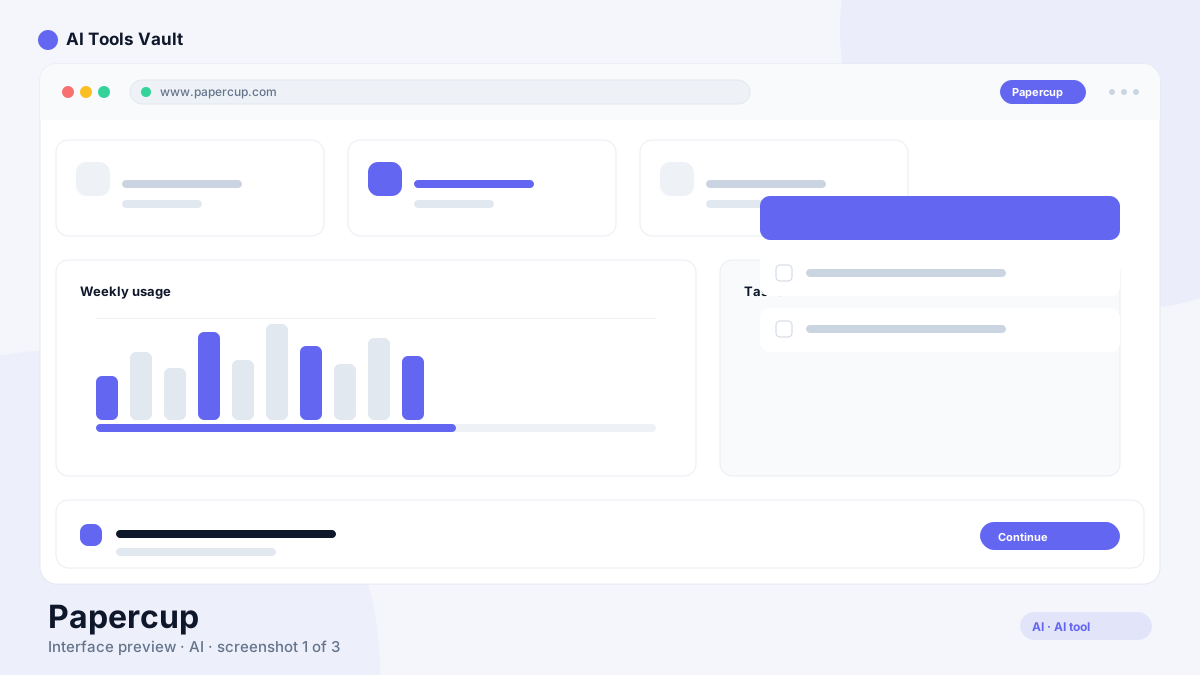
Papercup AI dubbing platform interface showing multilingual video localization workflow

What Is Papercup?

This AI video dubbing platform translates and voices video content into multiple languages. It combines synthetic voice generation with professional human review, producing dubbed output that preserves the emotional tone and delivery of the original speaker.
RWS acquired its intellectual property in June 2025. The platform now operates as RWS's AI dubbing orchestration layer for television, film, streaming, and digital content. It is positioned as a managed enterprise service rather than a self-serve tool.

and RWS

Before the acquisition, the company operated as a standalone AI dubbing service serving broadcasters and publishers. RWS purchased the intellectual property behind its voice synthesis and localization technology to integrate into its broader language services stack.
For buyers, this changes the evaluation context. The former papercup.com domain redirects to RWS. Pricing, delivery, and support now flow through RWS's managed enterprise model. The AI dubbing technology remains, but it sits alongside RWS's neural machine translation, human linguist network, and localization infrastructure.

How the Platform Works

The dubbing workflow follows six stages, each combining AI automation with human oversight.
  • Context-aware transcription with automatic speaker detection
  • AI translation refined by human post-editing for cultural accuracy
  • Voice selection and AI speech generation using ethically sourced voices
  • Adaptation and speech editing to adjust timing and delivery
  • Audio engineering and mixing for broadcast-ready output
  • Client review and platform-ready export with governance built in

Cross-Lingual Prosody Transfer

This platform uses cross-lingual prosody transfer, known as XLPT, to preserve the original speaker's tone, pacing, and emotional nuance when generating dubbed audio in a new language. Rather than producing flat, uniform speech, the AI models the delivery pattern of the source speaker and carries those characteristics into the target language.
Automatic speaker detection maintains character distinction across multi-speaker scenes. Voice cloning is available for approved cases with explicit talent permission, allowing the AI to replicate a specific voice across languages while respecting licensing requirements.

Pricing and Access

Pricing is not publicly listed. RWS provides custom quotes based on content type, source duration, target languages, dubbing style, voice approach, human review scope, and volume. The quote structure reflects the managed service model where the platform handles the full workflow from transcription through final mix.
Factors that affect cost include premium lip-sync versus phrase-sync voiceover, number of review rounds, audio description requirements, captions, delivery format, and integration needs. Buyers should compare cost per approved finished minute rather than headline per-minute rates.

Compare Plans & Pricing

Custom enterprise pricing based on content volume, languages, dubbing style, and workflow requirements

Starter

Custom

For small publishers getting started with AI video dubbing.

  • AI dubbing in 10-plus languages
  • Transcription and translation included
  • Standard voice library
  • Email support
  • Up to 30 minutes of video per month
Contact Sales
Most Popular

Business

Custom

For growing media teams with regular localization needs.

  • AI dubbing in 50-plus languages
  • Premium voice library
  • Cross-lingual prosody transfer
  • Priority support
  • Up to 3 hours of video per month
Contact Sales

Enterprise

Custom

For broadcasters and large publishers with high-volume needs.

  • AI dubbing in 100-plus languages
  • Custom voice creation
  • Advanced lip-sync
  • Dedicated account manager
  • Unlimited video volume
  • API access and integrations
  • SLA guarantees
Contact Sales

Who Should Use This Platform?

This service is built for broadcasters, streaming services, media publishers, and enterprises managing large video libraries. Organizations that produce content across multiple territories benefit most from the managed localization workflow.
Individual creators or small YouTube channels looking for self-serve AI dubbing should evaluate ElevenLabs or HeyGen instead. Those tools offer lower entry costs and DIY interfaces without requiring a sales engagement or enterprise contract.

vs [ElevenLabs](/tools/elevenlabs)

ElevenLabs offers self-serve AI voice generation and dubbing with a free tier, making it accessible for individual creators and small teams. It excels at voice cloning and text-to-speech quality across 30-plus languages.
This platform is a managed enterprise service focused on full video localization workflows. It includes human translation review, cultural adaptation, audio engineering, and final mix — services that ElevenLabs does not provide as part of its core product. The choice depends on whether you need self-serve voice generation or end-to-end managed dubbing.

Papercup vs [HeyGen](/tools/heygen)

HeyGen focuses on AI avatar videos and talking-head content with lip-sync, plus video translation in 40-plus languages. It offers self-serve plans starting with a free tier and is popular with marketing teams and creators.
This platform handles broadcast-grade dubbing for TV, film, and streaming content. The workflow includes human linguists, voice direction, audio engineering, and platform-ready export — production steps that HeyGen does not cover. For enterprise media localization at scale, it offers more comprehensive delivery.

Pros and Cons

The strongest advantage is the hybrid pipeline that pairs AI voice generation with professional human review. XLPT technology preserves speaker emotion and pacing, and the managed workflow handles everything from transcription through final audio mix. RWS backing adds enterprise infrastructure and a global linguist network.
The trade-offs are enterprise-only access, custom pricing with no transparency, and a service model that does not suit individual creators. Competitors like ElevenLabs and HeyGen offer self-serve options at lower price points.

Pros

  • Hybrid AI-plus-human workflow catches nuance that pure-AI dubbing misses
  • Cross-lingual prosody transfer preserves original speaker emotion
  • End-to-end managed delivery from transcription to final audio mix
  • Backed by RWS with 70-plus years of localization infrastructure
  • Tiered strategies for premium titles and large catalogues

Cons

  • Custom enterprise pricing only — no self-serve plans or public rates
  • Not designed for individual creators or small YouTube channels
  • Turnaround time varies with content complexity and language count
  • No free trial or public demo environment available

Alternatives to This Platform

The most relevant alternatives are ElevenLabs for self-serve AI voice generation and dubbing, HeyGen for AI avatar videos with video translation, and Synthesys for all-in-one voiceover and avatar video creation.
For pure AI dubbing at scale with human oversight, Rask AI and Dubs also serve the video localization market. The right choice depends on whether you need a self-serve tool or a fully managed enterprise workflow.
ElevenLabs AI tool logo

ElevenLabs

Voice & AudioFreemium
Best for: Voice cloning & realistic speech

Ultra-realistic AI voice generator and text-to-speech platform with voice cloning.

HeyGen AI tool logo

HeyGen

VideoFreemium
Best for: AI avatar videos & translation

AI avatar video platform for creating photorealistic presenter videos, dubbing into 40+ languages, and running interactive Video Agents.
Synthesys AI tool logo

Synthesys

VideoFreemium
Best for: AI voiceover, avatar video, and UGC ad creation

AI content studio generating voiceovers, avatar presenter videos, UGC-style ads, product demos, and voice clones from text scripts in 175+ languages.

Best For

Recommended use cases and scenarios where Papercup shines.

Frequently Asked Questions

Common questions about Papercup, answered.

What is Papercup AI?

An AI video dubbing platform that combines synthetic voice generation with human translation review. It is now owned by RWS and operates as a managed enterprise localization service for broadcasters, streaming services, and media publishers.

How does Papercup work?

The workflow covers transcription, AI translation with human post-editing, voice selection and AI speech generation, adaptation and timing adjustment, audio engineering and mixing, and client review before platform-ready export. RWS manages the full pipeline.

What is cross-lingual prosody transfer?

XLPT technology preserves the original speaker's tone, pacing, and emotional nuance when generating dubbed audio in another language. It models the delivery pattern of the source speaker rather than producing flat, uniform speech.

How much does Papercup cost?

Pricing is custom and based on content volume, target languages, dubbing style, voice approach, and workflow requirements. RWS does not publish a standard rate card. Contact sales for a scoped proposal.

Is Papercup free?

This service operates as a managed enterprise localization platform with custom pricing. There is no free tier or public trial.

Who is Papercup for?

Primarily broadcasters, streaming services, media publishers, and enterprises that produce video content and need to localize it for international audiences. Individual creators should evaluate self-serve alternatives.

How many languages does Papercup support?

The platform supports 100-plus languages for AI video dubbing. Exact language availability varies by project scope and is confirmed during the initial engagement with RWS.

Does Papercup have lip-sync?

Lip-sync is available as one production style. RWS also offers phrase-sync voiceover, UN-style voiceover, and straight narration. The appropriate style depends on content type, budget, and audience expectations.

What happened to Papercup?

RWS acquired the company's intellectual property in June 2025. The former papercup.com domain now redirects to RWS. The AI dubbing technology continues as part of RWS's managed localization services.

Reviews & Ratings

Share your experience

Your rating

Loading reviews...

Explore More Translation & Language Tools

Browse the full AI Tools Vault directory to compare Papercup with every translation & language tool, or line up your shortlist side by side.

Similar Tools

More Translation & Language tools you might like
Google Translate AI tool logo

Google Translate

Translation & LanguageFree
Best for: Anyone needing fast, free everyday translation - travel signs and menus, messages, websites, and quick document reads across roughly 250 languages

Free everyday translation from Google covering about 250 languages, with camera, voice, conversation, offline packs, document upload, and whole-webpage translation.
DeepL AI tool logo

DeepL

Translation & LanguageFreemium
Best for: Professionals, students, and businesses that need publication-ready translations of text and formatted documents, plus real-time voice interpretation for meetings

AI-first translation platform covering text, PDFs, Office documents, and real-time voice across 100+ languages, with glossaries and a developer API.
Microsoft Translator AI tool logo

Microsoft Translator

Translation & LanguageFreemium
Best for: Microsoft ecosystem translation

Microsoft's AI translation service supporting 130+ languages with text, document, and real-time conversation translation integrated across Office, Edge, and Azure.