Sora vs Gemini vs DeepSeek: What Changed in 2026
The old three-way comparison is out of date. Here is what changed: Sora is discontinued, and Gemini and DeepSeek are what remain.

The old three-way comparison is out of date. Here is what changed: Sora is discontinued, and Gemini and DeepSeek are what remain.
This comparison used to have three entries: Sora for video, Gemini for general work, DeepSeek for cheap reasoning. Two of them still exist. OpenAI switched Sora off during 2026, so any page still listing Sora plans or prices predates April.
Everything below was checked against vendor documentation on 2 October 2026. Where a price is not published, this article says so rather than estimating.
OpenAI discontinued the Sora web and app experiences on 26 April 2026, and the Sora API on 24 September 2026. Its help article on the discontinuation covers work that already exists: export runs through a sunset page at sora.chatgpt.com/sunset, with an email when the export is ready; after that window OpenAI permanently deletes data associated with your Sora use; and credits bought for Sora or ChatGPT stay usable, but only for Codex.
The API date matters more for anyone shipping a product. The OpenAI deprecation record lists the Videos API and the sora-2 and sora-2-pro model snapshots, all with a 24 September 2026 shutdown. That is a migration deadline, not a soft deprecation.
Text-to-video did not vanish with Sora. It moved into Google, whose plan comparison lists video generation in Gemini and Google Flow with Google Omni Flash video model access across the AI plans, and records Veo 3.1, Google Flow and Google Flow Music in more than 140 countries and territories. Video generation needs a paid AI plan, while image generation with Nano Banana 2 does not, which is the opposite of what several comparisons claim. And Sora never did editing: assembling and finishing clips is a separate category, where a dedicated editor such as Descript is the relevant comparison.
Gemini is a free tier plus three paid plans. One naming change catches people out: Google retired the Google AI Premium name, so the entry plan is now Google AI Plus and older reviews reference a plan that no longer exists.
| Plan | Price | Storage | Usage limits | Context window |
|---|---|---|---|---|
| No AI plan | Free | 15 GB | Standard | 32k tokens |
| Google AI Plus | $7.99 per month | 400 GB | 2x standard | 128k tokens |
| Google AI Pro | $19.99 per month, or $199.99 per year | 5 TB | 4x standard | 1M tokens |
| Google AI Ultra | From $99.99 per month, monthly billing only | 20 TB | 5x the Pro plan | 1M tokens |
Those are the US prices published by Google, checked 2 October 2026. They vary by country, and Ultra is sold at two usage levels.
The figure most comparisons get wrong is the context window. One million tokens is paid-tier only: 32k without a plan, 128k on AI Plus. Google describes 1M as roughly 1,500 pages of text or 30,000 lines of code, which is the gap between reading one document and reading a folder.
Two limits shape daily use more than the headline figure does. Limits are compute-based and refresh every five hours until you reach a weekly cap, so one very large request can consume a session. And Google notes that heavier features such as Deep Research can be unavailable to people without an AI plan during high demand, despite being listed as included. Exhaust a paid limit and you continue on Flash-Lite rather than stopping.
DeepSeek is a different shape of product, and the numbers usually quoted for it are out of date.
The consumer chat is still free. DeepSeek describes its official app as free with no ads and no in-app purchases, and the web version at chat.deepseek.com includes web search, a DeepThink reasoning mode, file upload with text extraction, and chat history. Older comparisons claiming DeepSeek cannot browse the internet are wrong.
The models have moved twice. DeepSeek retired the deepseek-chat and deepseek-reasoner names in July 2026, previewed V4 in April, and released V4.1-Flash in September as the smallest model in the V4 line, adding native visual understanding with a 1M token context window. Since 14 September 2026, requests sent to the retired deepseek-v4-pro name are served by V4.1-Flash at Flash prices.
Published rates for deepseek-flash, the V4.1-Flash model, are $0.003 per 1M cached input tokens, $0.15 per 1M uncached input tokens, and $0.60 per 1M output tokens. Those are off-peak rates; DeepSeek defines peak as 01:00 to 04:00 and 06:00 to 10:00 UTC on weekdays, excluding Chinese public holidays, when every rate doubles. Cache hits bill at roughly one fiftieth of the uncached input rate, so long fixed-context prompts cost far less than the headline suggests.
DeepSeek also publishes open weights for V4.1-Flash. That is why it gets called open. It does not make the hosted chat service private.
Rough notes into an outline. Gemini accepts fragments in any order and restructures them on request.
Working a problem in steps. DeepThink mode lets you interrogate one step at a time and check the reasoning before continuing.
Current information. Gemini reaches Google Search and cites sources through Deep Research; DeepSeek has web search in chat. Neither replaces opening the source.
Running it yourself. Only DeepSeek publishes weights, and V4.1-Flash is a large mixture-of-experts model, so self-hosting means server-class hardware rather than a spare laptop.
I use both for writing and research preparation, and neither has replaced checking sources.
Gemini earns its place by turning rough notes into a clearer outline. I dump unedited fragments, half sentences and timestamps, then ask for structure instead of a draft. It returns a better shape for a post than the one I started with.
DeepSeek is useful for step-by-step question exploration. I work through a problem one sub-question at a time and push back when a step looks thin. That back-and-forth is the value, not the final answer.
Neither gets it right the first time. I rewrite most of what comes back and fact-check every claim, because a confident outline with one wrong number in it is worse than no outline. Both made the start faster. Verification took about as much work as the generating did.
Both vendors train on user data by default, and both offer a way to change that. The differences are in how much each policy publishes and where processing happens.
Google, for Gemini Apps. The privacy notice, last updated 24 September 2026, states that a subset of chats are reviewed by human reviewers, including trained reviewers at service providers, to judge response quality and improve services. Reviewed chats are kept up to three years, disconnected from your account, and survive you deleting your activity. Temporary chats are not used to train its models, and with Keep Activity off and no feedback submitted, future chats are not used either. Activity auto-deletes after 18 months by default. The notice is blunt about the limit: do not enter confidential information you would not want a reviewer to see.
DeepSeek. The policy, last updated 10 February 2026, names Hangzhou DeepSeek Artificial Intelligence Co., Ltd. as controller and states that personal data is collected, processed and stored in the People's Republic of China. Training is listed as a purpose, including by monitoring interactions across devices. Users can opt out of training use, chat history can be deleted in settings, and account deletion is permanent.
Open weights are not a private hosted service. Published weights mean a team with the hardware can run the model without sending data to DeepSeek. They do not change what happens to anything typed into chat.deepseek.com. If data residency decides it for your organisation, the deciding variable is your deployment, not who published the weights.
Redact before you paste, and read the terms as a description of the product rather than a guarantee about your content.
Three checks beat a leaderboard:
One starting point: run both free tiers against real work for a week, then pay for whichever one actually blocked you.
No. OpenAI discontinued the Sora web and app experiences on 26 April 2026 and the Sora API on 24 September 2026. Existing work can be exported through the Sora sunset page, and Sora data is deleted permanently after that window.
Google lists video generation inside Gemini and Google Flow across its AI plans, with Veo 3.1 available in more than 140 countries and territories. It requires a paid plan, unlike image generation. OpenAI has not published a standalone Sora replacement.
In the United States, Google AI Plus is $7.99 per month with 400 GB, Google AI Pro is $19.99 per month or $199.99 per year with 5 TB, and Google AI Ultra starts at $99.99 per month on monthly billing only, above a free tier. Prices vary by country.
Yes for the consumer chat, which DeepSeek describes as free with no ads and no in-app purchases. The web version at chat.deepseek.com is free, with web search and a DeepThink reasoning mode. Payment applies to the API, which is billed per token.
Not accurately. The privacy policy states that personal data is collected, processed and stored in the People's Republic of China, and it lists training among its purposes. Users can opt out of training use and delete chat history. DeepSeek publishes open weights, so a team with suitable hardware can run the model itself, which is a separate arrangement from the hosted chat service.
Decide from the task, not the ranking. Pay for Google AI Pro or Ultra when you need the 1M context window, higher usage limits or the Google integrations, since free Gemini has a 32k window and standard limits. Pay for API access when per-token cost is what you are optimising. If neither limit is blocking you, start on the free tiers.
The original version of this comparison asked which of the three wins. That question closed in April 2026. What remains is narrower and more useful: which assistant fits your work, what it costs, and what its data terms say. Both vendors publish all of that, and it changes often, so check the sources rather than a summary of them.
Get our best AI tool reviews and guides delivered to your inbox each week. No spam, unsubscribe anytime.

Written by
Jawad Fiaz writes about AI tools and how to evaluate them, drawing on hands-on use, official product documentation, published pricing, and independent research rather than vendor marketing.
More reading on comparisons
 Comparisons
A practical comparison of the top AI avatar tools for podcast video snippets — HeyGen, Synthesia, D-ID, Colossyan, Captions, Descript, OpusClip and quso.ai, with 2026 pricing and workflows.
 AI Tools Vault Team
 Comparisons
Seven AI agent frameworks compared for 2026 — LangGraph, CrewAI, LlamaIndex, OpenAI Agents SDK, Google ADK, Microsoft Agent Framework, and PydanticAI — with current status, real trade-offs, and how to choose.
AI Tools Vault Team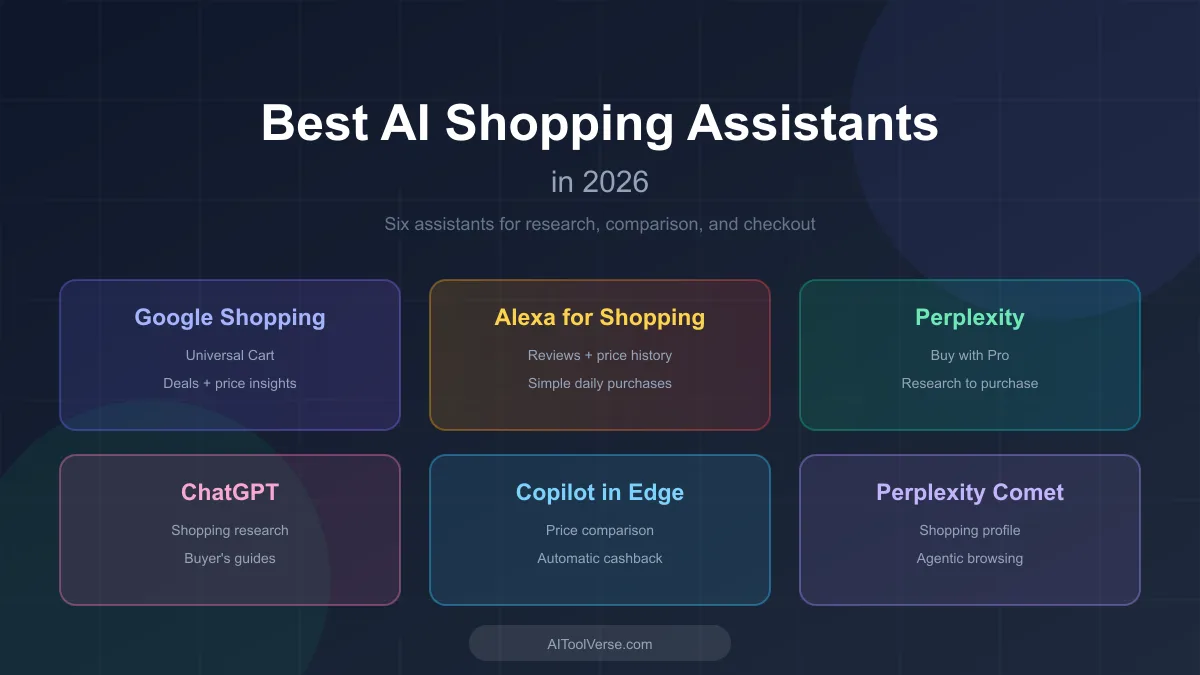 Comparisons
AI shopping assistants are reshaping how shoppers research products, compare prices, and check out. Here are the ones worth knowing in 2026.
AI Tools Vault Team