DealSize.ai Review: Features, Pricing, and What to Know
A practical DealSize.ai review: what the AI trading analysis assistant does, how its AI-Nalysis and ChartDS features work, what it costs, its limits, and who it is for.

A practical DealSize.ai review: what the AI trading analysis assistant does, how its AI-Nalysis and ChartDS features work, what it costs, its limits, and who it is for.
If you trade regularly, you have probably felt the pull of doing everything in one place: ask a question about a market, get a readable answer, glance at a chart, check the calendar for an upcoming release, and review how your recent trades went — all without juggling five tabs. That is the niche DealSize.ai tries to fill.
The platform is a browser-based trading intelligence workspace with an AI assistant at its center. It answers natural-language questions about the markets, covers several asset classes from a single dashboard, and can connect to a supported broker to review your real trade history. This review covers what it does, how the pieces fit together, what it costs, where it falls short, and who should consider it.
For the structured directory entry with full pricing tables, see the DealSize.ai listing.
DealSize.ai is an AI trading assistant and analysis workspace built for people who trade regularly but do not want to script their own indicators. Instead of writing formulas, you type a plain-English question — a request for the technical analysis of a currency pair, the RSI on a stock, or a broader market read — and the platform returns an answer that draws on live market data.
The product covers forex, commodities, cryptocurrencies, and stocks from one dashboard. Market utilities live side by side with the assistant: an economic calendar for high-impact releases, a news feed, and ChartDS, the interactive chart workspace where you can also connect a supported broker. For newcomers, the free tier is worth trying simply to see whether plain-language market analysis fits the way you work.
At its core, the platform answers questions about the market and helps you review your own trading activity. That combination is what separates it from a plain chatbot or a bare charting tool.
The assistant, called AI-Nalysis, is the centerpiece. You ask for an asset or an analysis and get back a readable interpretation that combines price action, indicators, and market context. Suggested questions appear on asset pages, so you can quickly pull up support and resistance levels, check whether a name is in an uptrend or downtrend, or request a full technical review.
Around the assistant sit the market utilities. The ChartDS workspace provides interactive charts with technical tools, and for supported brokers you can connect your live account so positions and trade history appear in the same space where you analyze the market. You can track open positions, see upcoming news and events near the names you hold, and in some cases place market orders from the chart. The platform also supports creating a demo trading account directly from ChartDS, so you can practice without risking real capital.
The workflow is straightforward. You log into the web application, pick an asset or open the assistant, and ask your question in natural language. Behind the scenes the platform keeps a library of common indicators — moving averages, RSI, MACD, ADX, oscillators, and pivot points — that the assistant can reference to ground its answers. That context is what separates it from a generic chatbot answering from memory with no market data.
For the trade-review side, the flow depends on broker support. If your broker is supported, you connect it, and your real trades and positions come into the workspace. The platform then analyzes that history and surfaces patterns and insights alongside the market data you are already viewing. If your broker is not supported, you lose that specific angle but can still use the assistant and charts.
Retail and intermediate traders get the most out of it: people who want a fast second opinion on an instrument, a quick technical read, and a single place to see how their own trades are performing without exporting spreadsheets. Because it is browser-based, it works across devices and needs no setup.
Professionals who depend on backtesting, deep community features, or full charting controls will likely find it light, and should keep their dedicated platforms for that work. DealSize.ai is best treated as a complement to a serious trading setup, not a replacement for it.
DealSize.ai runs on a freemium model with three tiers that mostly scale the number of monthly AI queries and threads. The free Retail plan is enough to test whether the workflow suits you, while the paid tiers lift limits for people who trade frequently.
Pricing sits at approximately $25 per month for the Desk tier and $55 per month for the Institutional tier. The exact differences between the paid levels are not spelled out in full detail publicly, so check the official pricing page for the latest breakdown before you upgrade. As with most trading services, treat the pricing page as the authoritative source, since plans can change.
Strengths: Accessibility is the clear selling point. You get technical analysis, news, an economic calendar, charts, and broker-connected trade review in one browser workspace, and you talk to it the way you would ask a colleague — in plain English, with no scripts to write. Multi-asset coverage in one place is genuinely convenient, and the freemium model means you can test it before paying.
Limitations: Broker compatibility is not detailed for every region, and if your broker is unsupported you lose the trade-review angle. The exact paid-tier feature differences are not fully disclosed. There is no built-in backtesting or community features. And the platform is transparent that AI output is general market information, not investment advice, so insights are input to your own decisions rather than instructions.
For an AI-assisted view of trading and markets, DealSize.ai is not alone. The closest comparisons among other AI-driven analysis tools are worth knowing about.
MarketAlerts AI watches for insider trades and filings and alerts you to them, which makes it a notification service rather than an analysis assistant. Uptrends AI scores news sentiment for a faster read on market mood. DealSize.ai instead answers your own questions about the market and reviews your own trade history — more of an on-demand analysis assistant than an alert or sentiment tool.
It also differs from full charting suites. DealSize.ai is not meant to replace a serious charting terminal; it is a practical layer that gives fast AI commentary alongside technical tables and a consolidated view of your performance. If you need full charting and backtesting, a dedicated platform remains the stronger choice.
DealSize.ai is a reasonable fit for active retail traders who want AI-assisted market analysis and a single place to review their own trades. Its value depends on how well those capabilities match your existing workflow — particularly whether your broker is supported for the trade-review angle.
The free tier is the sensible way to decide. If plain-English analysis and broker-linked review genuinely save you time, the paid tiers are reasonably priced. If you depend on backtesting, community features, or full charting control, this tool is not the place to get them. Treat its AI output as general market information for your own analysis, not as investment advice.
If you are exploring AI-assisted finance tools, browse the wider collection of finance and market tools in the AI Tools Vault directory.
What is DealSize.ai?
DealSize.ai is a browser-based AI trading intelligence workspace. It answers plain-English questions about the markets, covers forex, crypto, stocks, and commodities from one dashboard, and can review your broker-linked trade history.
What does DealSize.ai do?
It combines an AI assistant called AI-Nalysis with ChartDS charts, live market data, an economic calendar, and news. You ask natural-language questions and get back analysis grounded in indicators such as RSI, MACD, and ADX, and you can connect a supported broker to see your real trades alongside the analysis.
How does DealSize.ai work?
You log into the web app and ask for an asset or an analysis in plain English. The AI-Nalysis assistant answers using a library of technical indicators and live market context. For broker-linked trade review, you connect a supported broker so positions and history come into the same workspace.
How much does DealSize.ai cost?
DealSize.ai runs on a freemium model. There is a free Retail tier with limited monthly queries, a Desk plan at about $25 per month with 500 queries, and an Institutional plan at about $55 per month with 1,500 queries. Check the official pricing page for the current details.
Is DealSize.ai free?
Yes, there is a free Retail tier with limited monthly AI queries and threads. Paid plans add higher query limits, more conversation threads, and deeper analytics for traders who use it heavily.
Who is DealSize.ai for?
It is aimed at active retail and intermediate traders who want a fast AI-assisted read on an instrument and a single place to review their own trades, rather than a wall of spreadsheets. It is browser-based, so there is nothing to install.
Is DealSize.ai a substitute for a charting terminal?
No. It is a complementary analysis assistant, not a replacement for a full charting suite. Serious charting, backtesting, and deep community features still belong on a dedicated platform.
Does DealSize.ai provide investment advice?
No. The platform labels its output as general market information for educational purposes and is transparent that it is not investment advice. You make the final trading decisions.
Get our best AI tool reviews and guides delivered to your inbox each week. No spam, unsubscribe anytime.

Written by
Editorial Team
The AI Tools Vault editorial team researches, tests, and reviews the best AI tools across every category.
More reading on tool reviews
 Tool Reviews
AI chatbot aggregators let you use ChatGPT, Claude, Gemini, and more in one subscription. Here are the best multi-model platforms compared.
 Alex Rivera
 Tool Reviews
The 10 best AI tools in 2026 you should be using — tested hands-on across chatbots, image, video, coding, and writing, with pricing and value verdicts.
Alex Rivera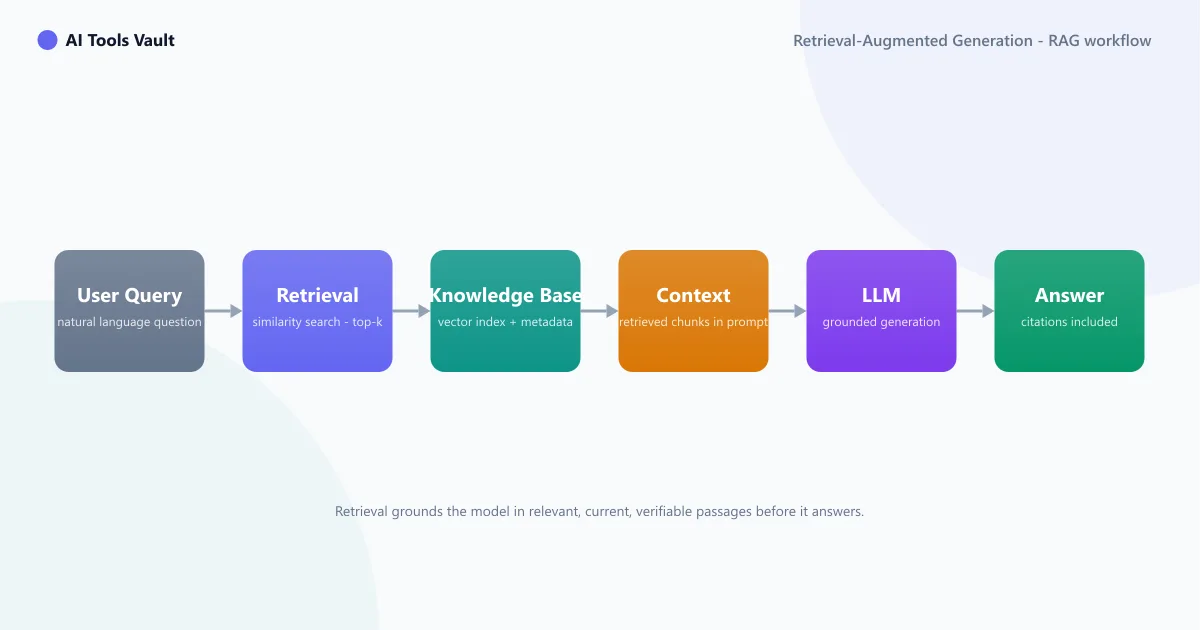 Guides & How-To
RAG explained in plain language: how retrieval-augmented generation grounds large language model answers in your own current, private data, how the pipeline works, and when it is worth building.
 AI Tools Vault Team