Best for: AI-powered no-code MVP building with a freelancer marketplace
MarsX is an AI-powered no-code and low-code development platform that combines reusable micro-apps, AI logic generation, and a freelancer marketplace to build full-stack apps fast.
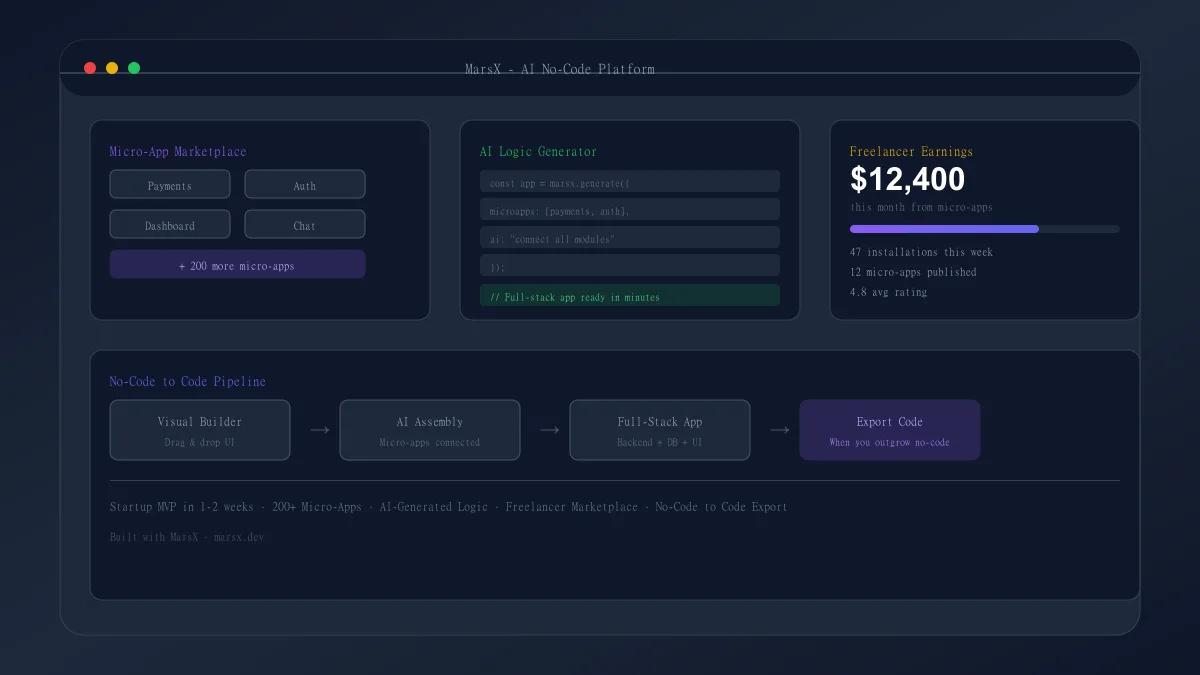
MarsX is an AI-powered no-code and low-code development platform built around reusable micro-apps. Instead of coding every feature from scratch, you combine proven building blocks — chat modules, payment processors, dashboards, user authentication — and the AI wires the data, API layer, and frontend together.
The result is a full-stack product with backend, database, and UI, assembled in hours rather than weeks. That combination of AI generation and reusable components is what separates this platform from single-purpose app builders: you get the speed of no-code with the flexibility of low-code, and developers can go deeper with the DevKit and VS Code plugin when they need custom logic.
MarsX AI Platform Features
The platform packs several distinct capabilities into one product. The AI generator creates connecting logic between micro-apps, handles database schema design, and produces API endpoints automatically. The visual builder lets non-coders assemble screens and workflows by dragging components, while the DevKit and VS Code plugin give developers full control over the generated code.
It also supports no-code to custom code conversion: you can start with the visual builder and export the project as clean code when you outgrow the no-code layer. That path matters for startups that begin with an MVP and later need to hire engineers — the code is real, portable, and not locked into a proprietary runtime.
AI wires data, APIs, and UI between micro-apps
Visual builder for non-coders with drag-and-drop screens
DevKit and VS Code plugin for developers
No-code to custom code export for growing products
MarsX Micro-App Generator
The micro-app concept is the core differentiator. Each micro-app is a self-contained, reusable feature — a chat widget, a payment flow, a dashboard panel, a booking calendar — that works across projects. Instead of rebuilding common functionality every time, you drop in a proven micro-app and let the AI connect it to your data and design.
The marketplace hosts hundreds of micro-apps built by the community and by professional developers. You can use existing ones, customize them, or build your own and publish them for other users. This turns app development from a blank-canvas exercise into an assembly process, where the hard parts are already solved and the focus shifts to what makes your product unique.
Reusable feature blocks for chat, payments, dashboards, and more
AI connects micro-apps to your database and UI
Community marketplace with hundreds of pre-built components
Build and publish your own micro-apps for revenue
How to Build a Startup MVP with MarsX
Building a startup MVP on the platform follows a straightforward path. Start by describing your product in the AI generator, pick the micro-apps that match your core features — user auth, payments, dashboards, messaging — and let the AI assemble the full-stack scaffold. Then refine the UI in the visual builder, connect your data sources, and deploy.
The typical timeline for a working MVP is one to two weeks, compared to one to three months with traditional development. For founders validating an idea before raising funding, that speed advantage is significant: you can test with real users, gather feedback, and iterate without burning through runway on development costs. Pricing keeps the barrier low — the Free plan covers exploration, and Pro at $19 per month gives you enough to launch a real product.
MarsX Marketplace — Earning as a Freelancer
The marketplace is not just a component library — it is a revenue platform. Freelancers and agencies build micro-apps, publish them to the marketplace, and earn when other users install them. This creates a two-sided ecosystem: builders get paid for their work, and app creators get access to a growing library of production-ready features.
For freelancers, the marketplace is a way to productize development work. Instead of trading hours for money on custom projects, you build a micro-app once and earn from every installation. Popular micro-apps in categories like payments, analytics, and user management generate recurring income with minimal maintenance. The marketplace also serves as a portfolio — agencies that build high-quality micro-apps attract custom work from platform users who need tailored solutions.
MarsX Pricing — Free vs Paid Plans
The platform is freemium with a usable free tier. The Free plan lets you explore the micro-app marketplace, build sample projects, and test the AI generator without paying. It is enough to learn the platform and build a small prototype, though it limits storage and project count.
Pro at $19 per month removes those limits: you get more projects, custom domain deployment, and priority support. Scale at $49 per month adds team collaboration, private micro-apps, and higher usage limits for agencies and growing teams. The pricing sits in the middle of the no-code market — cheaper than Bubble.io's comparable plan, and significantly cheaper than hiring a developer for the same scope.
MarsX vs Bubble.io
MarsX and Bubble.io are both no-code platforms for building web apps, but they take different approaches. Bubble.io is a mature, full-featured visual editor with deep customization and a large plugin ecosystem — it is the most flexible no-code builder on the market, but that flexibility comes with a steeper learning curve and slower iteration speed.
This platform trades some of that depth for speed. The micro-app approach means you assemble proven components rather than building from scratch, and the AI handles the plumbing between them. For startup founders who need an MVP in weeks rather than months, it is the faster path. For products that need deep, custom logic and maximum design control, Bubble.io remains the more powerful option. The right choice depends on whether speed to market or absolute flexibility matters more for your stage.
Best MarsX Alternatives
The best alternatives depend on what you are building. For prompt-to-app speed, Bolt.new and Lovable generate full-stack apps from a single description with minimal setup. For data-driven apps and portals, Softr connects to your existing databases. For full-stack development with code control, Replit AI offers a cloud IDE with AI assistance. For visual app building with deep customization, Bubble.io remains the benchmark.
Base44
Web & App BuildersFreemium
Best for: Vibe coding & no-code app building
The vibe coding app builder that turns plain-English prompts into full-stack apps — frontend, backend, and database included.
AI no-code app builder that turns plain-language descriptions — or an existing AI chat — into working applications with hosting, data, and logic included.
This platform is one of the most capable no-code AI builders thanks to its micro-app architecture, AI logic generation, and marketplace ecosystem. It works for both coders and non-coders, supports no-code to code conversion, and keeps pricing accessible. The tradeoffs are a steeper learning curve than pure prompt-to-app tools, sparse documentation for advanced features, and the reality that complex apps still benefit from some custom code. For startup founders building MVPs and freelancers looking to earn from reusable components, those tradeoffs are worth it.
Pros
Reusable micro-app building blocks speed up development
AI generates connecting logic, APIs, and database schema
Marketplace lets freelancers earn from built micro-apps
Works for both coders and non-coders with DevKit and visual builder
Cons
Steeper learning curve than pure prompt-to-app tools
Documentation can be sparse for advanced features
Complex apps still benefit from some custom code
Best For
Recommended use cases and scenarios where MarsX shines.
Yes. It has a free plan that lets you explore the micro-app marketplace, build sample projects, and test the AI generator. Paid plans start at Pro for $19 per month and Scale for $49 per month.
What is MarsX used for?
It is used to build full-stack web apps — MVPs, SaaS products, marketplaces, dashboards, and internal tools — using reusable micro-apps and AI-generated logic instead of coding from scratch.
How does MarsX compare to Bubble.io?
It is faster for MVPs because the micro-app approach assembles proven components with AI wiring. Bubble.io offers deeper customization and a larger plugin ecosystem but has a steeper learning curve and slower iteration.
Can I make money on the MarsX marketplace?
Yes. Freelancers and agencies build micro-apps, publish them to the marketplace, and earn when other users install them. Popular micro-apps generate recurring income with minimal maintenance.
Do I need to code to use MarsX?
No. The visual builder and AI generator handle most projects for non-coders. Developers can go deeper with the DevKit, VS Code plugin, and API access, and it supports exporting no-code projects to custom code when you need more control.
Reviews & Ratings
Loading reviews...
Explore More Web & App Builders Tools
Browse the full AI Tools Vault directory to compare MarsX with every web & app builders tool, or line up your shortlist side by side.