Skip to content
Dr. Muscle Health & Fitness AI tool logo

Dr. Muscle Review: AI Workout Trainer & Pricing 2026

Health & FitnessFreemium
Best for: AI-powered progressive overload workout planning

Dr. Muscle is an AI personal trainer app that auto-generates progressive overload workout plans using daily undulating periodization (DUP) and adapts in real time.
4.5(850)
Founded 2016
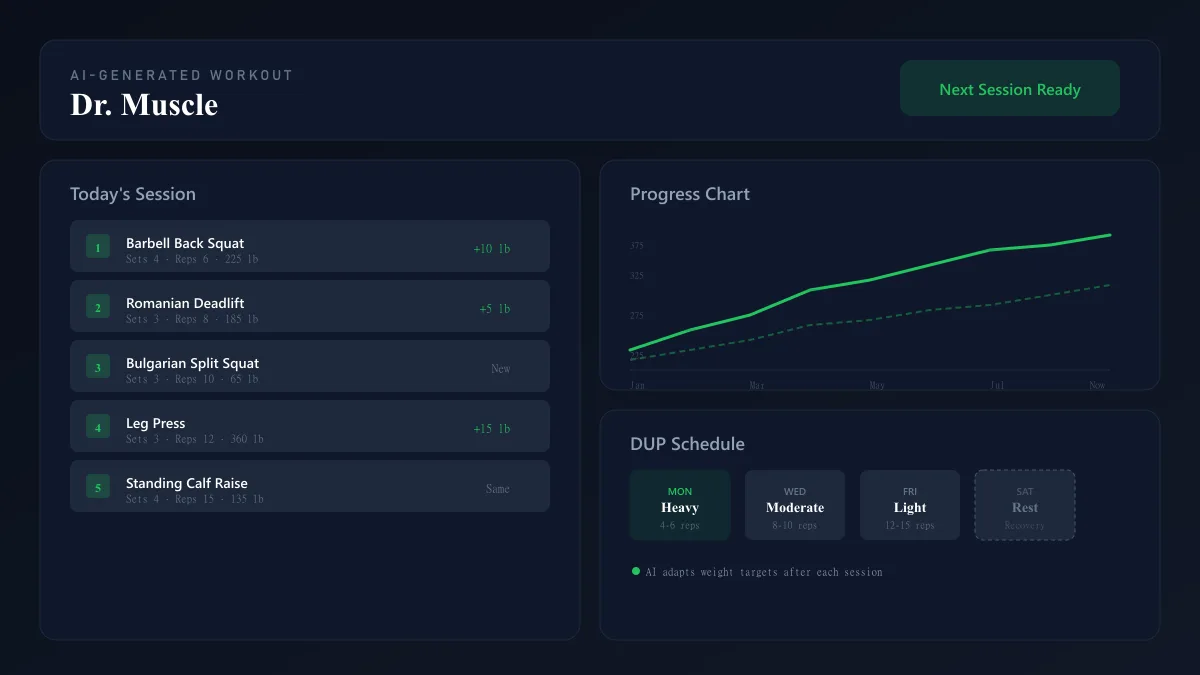
Dr. Muscle AI personal trainer app showing auto-generated progressive overload workout plan

What Is Dr. Muscle?

Dr. Muscle is an AI-powered personal trainer app that automates workout programming using daily undulating periodization. Instead of following a static program, you log your sets and reps after each workout, and the AI adjusts your next session accordingly.
Founded in 2016 by exercise science PhD Carl Juneau, the app bridges the gap between following a fixed spreadsheet and hiring an expensive coach. It handles exercise selection, volume, intensity, and deload timing so you can focus on training. Explore more AI fitness and training tools at AI Tools Vault.

Key Features

The app includes AI-generated workout plans, real-time performance adaptation, DUP periodization, an exercise library with video demonstrations, progress analytics, and a meal plan add-on. It works on iOS, Android, and the web through the newer Dr. Muscle X interface.
The core advantage is automation. You do not need to program deloads, track volume, or decide when to increase weight. The AI handles the programming logic and presents a ready-to-execute session each time you open the app.
  • Daily undulating periodization varies intensity each session
  • AI adjusts weight targets based on logged performance
  • Automatic deload scheduling prevents overtraining
  • Exercise selection adapts to available equipment
  • Apple Health integration for tracking

How the AI Workout Planning Works

The platform uses daily undulating periodization, which varies rep ranges and intensity across sessions rather than following a linear weekly progression. One day you might lift heavy for sets of 4–6, and two days later you perform higher-rep hypertrophy sets.
The AI monitors your logged performance and adjusts weight targets, rest periods, and exercise order in real time. If you underperform on a lift, it dials back the next session. If you exceed expectations, it increases the challenge automatically.

How to Get Started

Getting started takes just a few minutes:
  • Download the app on iOS, Android, or open Dr. Muscle X in your browser
  • Create an account and start your 2-week free trial of all premium features
  • Set up your profile with training goals and available equipment
  • Log your workouts after each session so the AI can track your performance
  • Review the AI-generated plan each time you open the app
  • Continue on the free plan or subscribe to Premium for full access

Pricing and Plans

The app offers a free tier with limited features, a Premium plan at $48.99 per month, and an Annual plan at $399.99 per year that saves over 30%. A meal plan add-on with recipes and shopping lists is available for $18.99 per month or $99 per year.
The free plan lets you try the interface with one AI recommendation per day plus free nutrition guidance. The full AI adaptation, unlimited recommendations, and advanced features like automated deloads and body fat tracking require Premium.

Dr. Muscle vs Fitbod vs WHOOP

Fitbod, WHOOP, and this app all target gym-goers but solve different problems. This tool specializes in progressive overload programming with DUP methodology. Fitbod uses machine learning to rotate muscle groups and balance volume. WHOOP focuses on recovery, sleep, and strain tracking rather than exercise programming.
If you want a coach that writes your program, this app is the strongest choice. If you want muscle-group rotation, Fitbod is simpler. If you care most about recovery data, WHOOP adds that layer. Many serious lifters combine this app for programming with WHOOP for recovery insights.

Pros and Cons

This app automates progressive overload better than most fitness apps, and its DUP methodology produces well-rounded programming. The real-time adaptation keeps workouts challenging without manual adjustments.
The main drawback is the $48.99 monthly price, which is steep compared to alternatives like Fitbod at roughly $8 per month. It also focuses primarily on strength training, so cardio and mobility athletes may find it limited.

Pros

  • Auto-generated progressive overload workouts
  • Adapts in real time to logged performance
  • Meal plan add-on available
  • Founded by exercise science PhD

Cons

  • Premium price at $48.99/mo
  • Primarily strength training focused
  • Trustpilot reports some cancellation issues

Frequently Asked Questions

Best For

Recommended use cases and scenarios where Dr. Muscle shines.

Frequently Asked Questions

Common questions about Dr. Muscle, answered.

What is this app?

Dr. Muscle is an AI-powered personal trainer app that generates progressive overload workout plans using daily undulating periodization. It adapts in real time based on your logged performance.

How does the AI workout planning work?

You log your sets and reps after each workout, and the AI adjusts your next session's weight targets, sets, and reps. It uses daily undulating periodization to vary intensity across sessions.

Is there a free plan?

Yes. The free plan provides one AI exercise recommendation per day and free nutrition guidance. Premium at $48.99/month or $399.99/year unlocks unlimited recommendations, automated deloads, and advanced features.

How much does Premium cost?

Premium costs $48.99 per month or $399.99 per year. A meal plan add-on is available for $18.99 per month or $99 per year. There is also a limited free plan.

What is DUP?

DUP stands for daily undulating periodization. It varies rep ranges and intensity across training sessions to stimulate strength, hypertrophy, and endurance within the same week.

How does it compare to Fitbod?

This app uses DUP methodology and adjusts weight targets in real time, while Fitbod uses machine learning to rotate muscle groups. Dr. Muscle is more expensive but offers deeper periodization.

Who should use this app?

It is best for serious lifters and bodybuilders who want structured progressive overload programming without hiring a coach. It works well for powerlifting, hypertrophy, and general strength training.

Reviews & Ratings

4.5

Based on 850 reviews

5
71%
4
16%
3
7%
2
4%
1
2%

Share your experience

Your rating

Loading reviews...

A

Alex Chen

Game changer for my daily workflow. The quality of output consistently surprises me.

S

Sofia Rossi

I've tried most tools in this space and nothing comes close. Highly recommended.

D

Daniel Kim

The best investment I've made this year. Saves me hours every single week.

Explore More Health & Fitness Tools

Browse the full AI Tools Vault directory to compare Dr. Muscle with every health & fitness tool, or line up your shortlist side by side.

Similar Tools

More Health & Fitness tools you might like

WHOOP AI tool logo

WHOOP

Health & FitnessPaid
Best for: AI-powered fitness recovery, sleep tracking, and membership-based wearable coaching

WHOOP is a subscription-based fitness wearable that tracks sleep, recovery, strain, and stress 24/7 with AI coaching and membership plans starting at $199 per year.

4.6(1.2k)
Visit Website
Fitbod AI tool logo

Fitbod

Health & FitnessFreemium
Best for: AI workout planning that adapts to your gym progress

Fitbod is an AI workout planning app that uses machine learning on your logged history to generate personalized strength training sessions that adapt to muscle recovery.

ChefGPT AI tool logo

ChefGPT

Health & FitnessFreemium
Best for: AI recipe generation, calorie tracking, and macro-focused meal planning

ChefGPT is an AI recipe generator and meal planner with PantryChef, MasterChef, MacrosChef, and MealPlanChef engines for personalized cooking guidance and calorie tracking.